Padel Court Etiquette Beyond Basics UK 2026
Advanced padel etiquette UK 2026: between-game conventions, mixed doubles, club culture, social conventions beyond basics.
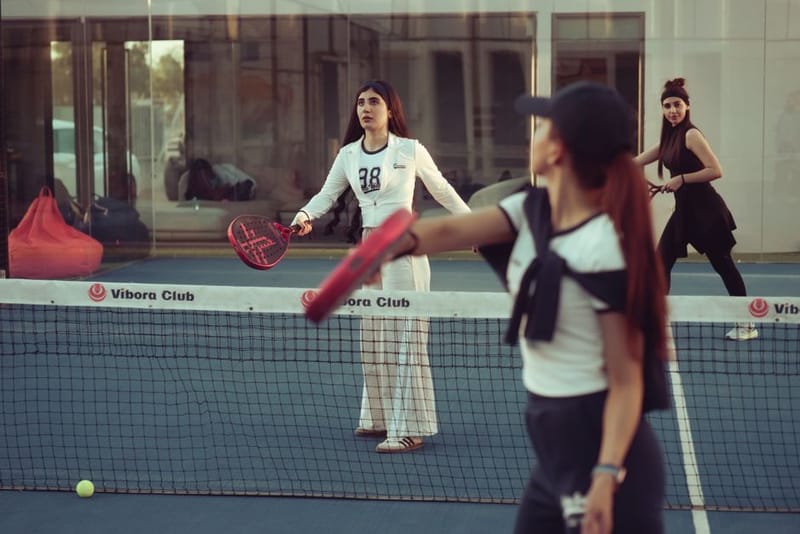
Padel etiquette goes beyond 'don't slam balls'. This guide covers the conventions that experienced UK padel players follow + new players often miss.
Before play - arrival + warm-up
Setting up well.
Arrival timing:
- Arrive 10-15 min before your slot. Most clubs allow on-court 5 min before slot starts.
- Use the spare 5-10 min for warm-up (stretches, light movement) outside court.
Equipment + gear:
- Padel-specific or court tennis shoes (non-marking soles required at most clubs).
- Sports clothes - no jeans, no swimwear, no inappropriate logos.
- Bring your own ball can if club doesn't provide (most clubs do; check on first visit).
- Water bottle (most clubs have refill stations).
Warm-up on-court:
- First 3-5 min: rally at half-pace; not full match play.
- Common UK convention: don't start serving practice within first 2 min - let everyone warm in.
- Don't smash balls at neighbours' courts during warm-up (most UK clubs have multi-court setups).
During the match
Key conventions.
Calling the score:
- Server announces score before each point. Format: '15-30' (server first; receiver second).
- If disagreement: pause + check. No assumption that server is right.
- Score-keeping fundamental - if you forget, ask 'what's the score?' politely.
Line calls:
- Receiving team makes line calls (where the ball lands on their side).
- Server's team doesn't dispute receiving team's calls.
- 'Out' or 'long' must be called immediately - delayed calls invalidate.
- Close call? Concede to opponent. 'Honesty over winning' is club culture.
Lets (replay points):
- Server hits net cord that lands in service box: let; replay first serve.
- Hindrance (ball from another court, animal, weather): let; replay point.
- Receiver not ready when server serves: let; replay first serve.
Ball retrieval:
- Player nearest the ball retrieves; don't make partner / opponent fetch your shot.
- Roll or tap-throw the ball back; don't smash from across court.
- If ball lands in neighbour's court: wait for their point to end + ask politely.
Mixed doubles specifics
Often the trickiest etiquette.
The unwritten rules:
- Don't target the weaker player exclusively: technically allowed in tournaments but considered poor sport in recreational mixed doubles. UK norm: alternate targeting; mix shots between partners.
- If skill gap is large: pair-swap between games (winning pair splits up) is common UK convention.
- Power-targeted shots at less-skilled opponent: avoid hard smashes / drives at someone clearly outclassed.
- Encouragement is genuine: 'great shot!' (real or coach-style) is well-received.
What's considered poor mixed-doubles etiquette:
- Repeatedly hitting hard volleys at a lower-skill player.
- Mansplaining technique mid-game to a partner.
- Loud commiseration on partner's missed shots.
- Not rotating servers between games (in 4-game block format).
What IS good etiquette:
- Encouraging weaker partner after missed shots.
- Mixing shot direction so all players get involved.
- Suggesting pair-swap if matches are lopsided.
- Praising opponents' good shots.
Between games + changeovers
Brief breaks.
Changeover (after odd games):
- Standard 90-second break.
- Sit briefly; hydrate; chat with partner.
- Eat a snack / banana if needed.
Phone use:
- Phone on silent / vibrate during play.
- Brief texts between games: fine.
- Long calls / video calls: not appropriate during match.
- Music: only via personal earphones if alone on court (typically not in matches).
Drinking + eating:
- Water encouraged; sports drinks fine.
- Alcohol DURING play: not OK. Drinks after sessions in club bar: standard UK culture.
- Food: light snacks (bar, fruit) during changeover OK; full meal during session not OK.
Coaching from sidelines:
- Tournament play: no coaching during games (rule enforced).
- Recreational play: brief partner tips fine ('try lob to back wall next');; extended coaching by spectator generally not done.
- Watching as spectator: comments fine between points; not during play.
End of session - cleanup + transition
Leaving the court.
Time-to-finish:
- Finish on-court play 5 min before slot ends.
- Allow 5 min for handshakes + ball collection + exit.
- Next bookers need their warm-up time.
Ball collection:
- Collect ALL balls; don't leave any behind on court.
- Most clubs use 4 balls per session - count them at end.
- Lost balls (over fence, into bar area): retrieve if visible.
Handshake / fist-bump:
- Standard end-of-match courtesy.
- Acknowledge opponents (good game, good shot, etc).
- Acknowledge partner.
Sweat + towel use:
- Use a personal towel on bench; don't drape on net or rails.
- Wipe down bench if you've sweated heavily.
Tipping:
- Most UK padel clubs have staff for ball-collection / court maintenance.
- Tipping not universal - GBP 1-2 appropriate if staff member helped (e.g. fetched balls, provided towels).
- Premium clubs (Pure Padel) typically have staffed amenities - tipping expected for direct service.
Common etiquette mistakes new players make
Things to avoid.
- Smashing balls during warm-up: warm-up is for getting feel, not match practice.
- Disputing line calls aggressively: ruins atmosphere; concede gracefully.
- Targeting weaker mixed-doubles opponent exclusively: technically allowed but poor sport.
- Hogging the ball / not retrieving: shared responsibility; pull your weight.
- Loud frustration on missed shots: contagious; brings down group mood.
- Phone-checking during play: disrespectful to partner + opponents.
- Late arrival without explanation: cuts into others' warm-up.
- Refusing partner suggestions on tactics: doubles is a team sport; openness matters.
Club culture variations UK 2026
Different vibes at different venues.
Premium padel clubs (Pure Padel, premium-tier):
- More formal etiquette.
- Professional setting; dress code semi-formal sport.
- Staffed amenities; tipping expected.
- Booking-only access; structured social events.
Mid-range padel clubs:
- Friendly + welcoming; less formal.
- Mix of competitive + recreational play.
- Some staff but largely self-service.
- Drop-in sessions common.
Community / leisure-centre padel:
- Most relaxed atmosphere.
- Mixed-skill drop-in sessions; rotate partners.
- Less formal dress.
- Typically subsidised pricing.
LTA Tennis-club padel courts:
- Tennis-club culture (typically more formal).
- Tennis-club members get priority; non-members need session booking.
- Sometimes feels tennis-adjacent rather than authentic padel culture.