Padel Etiquette UK: The Unwritten Rules for Club Play
From walking behind active courts to who calls the score, the unwritten padel etiquette rules every UK club player should know - written down at last.
Padel is the fastest-growing racket sport in the UK, which means a lot of newer players are stepping onto a court for the first time without picking up the unwritten conventions that veterans take for granted. The rules in the rulebook tell you how the game is scored. Padel etiquette tells you how to be the kind of player and partner other club members want to book a session with. This guide covers the conventions that come up most often at UK clubs.
What should you sort before stepping on court?
Arrive on time. Most UK clubs book courts in 60- or 90-minute slots and run them back-to-back. Arriving five minutes before your slot to warm up off-court is normal; arriving fifteen minutes late and expecting your full hour is not. If you're going to be late, message your group or the club.
Wear the right shoes. Padel-specific or clay-court tennis shoes with herringbone soles. Running shoes mark the court and don't grip on the artificial-grass surface - most clubs will ask you to change before letting you play. If you're new and don't have padel shoes yet, see our guide to choosing padel shoes.
Bring your own balls if your booking is unmatched. Club mixers and league nights usually provide balls, but pay-as-you-go bookings expect you to bring a fresh tube. New balls last around two full sessions before the pressure drops noticeably.
Check the court is clear before walking on. Glass doors swing into the playing area, and walking onto an active court without checking is one of the most common avoidable accidents. Wait at the door, make eye contact with the players if a point is in play, and only step on between points.
Which on-court conventions matter most?
Padel is a doubles game played in tight quarters, with glass walls and a small court. The unwritten rules that get used most often are about not disrupting other players and keeping the rally flowing.
Don't walk behind a court while a point is being played
Movement behind the glass is highly visible and breaks players' focus. Wait at the corridor or the door until the point ends, then cross.
Return loose balls only between points
If a ball rolls onto your court mid-point, your point continues - the players whose ball it is should not chase it. Wait until the point ends, then roll the ball back along the floor. Never throw a ball across courts.
Call your own service line
The server's team is responsible for calling their own faults. If you're unsure whether the serve was good, replay it. Most club players err generously toward the server - it keeps the game moving.
Make line calls only on your own side
If the ball lands on your side of the net, the call is yours and your partner's. Calling balls on your opponents' side is considered rude. If they ask, you can give an opinion, but don't volunteer it.
Announce the score before each serve
The server says the score out loud before bouncing the ball. Server's score first, then receiver's. This eliminates 90% of scoring disputes at club level.
Apologise for a lucky shot off the net cord or frame
A raised hand and a quick 'sorry' acknowledges a ball that clipped the net or frame in your favour. Universal in racket sports - padel included.
How do you avoid being a bad doubles partner?
Padel is played in pairs, and the partnership is the social heart of the game. Good doubles etiquette is what makes you the player others want to book in with.
Encourage, never criticise. Mistakes happen to everyone, and a bad shot followed by a glare from your partner makes the next shot worse. The professional convention - copy it at club level - is to celebrate good shots, shrug off bad ones, and never analyse a missed shot mid-match. Save coaching for after the session, if at all.
Cover your own side. Padel positioning is roughly half the court each, and the most annoying habit at the club level is the player who poaches every ball, forcing their partner into a passive role. Trust your partner to handle their balls; communicate before the point if you want a switch.
Call 'mine' or 'yours' early on balls down the middle. Hesitation is the most common source of unforced errors in club doubles. A clear, early call resolves who hits the ball before either player has to make a decision under pressure.
Don't celebrate your opponents' mistakes loudly. Acknowledging a great winner from across the net is normal. Cheering when an opponent double-faults or hits a ball into the back glass is not - it's the single fastest way to be remembered as the worst player at the club.
What are the UK mixed-doubles conventions?
Most UK club padel is played mixed, and most mixed sessions follow conventions that aren't in the rulebook but are universally observed.
Pace the ball to the player, not the gender. The polite default is to hit at the level your opponent shows, not at the level you assume from gender. Smashing every ball at the weakest player on the other team is technically allowed but socially poor - most mixed mixers expect a more even spread of shot direction.
Don't 'coach' a partner you've just met. Volunteered advice mid-rally to someone you've played with for ten minutes is consistently mistimed and rarely welcome. If they ask between points, share. If they don't, focus on your own game.
Switch partners regularly in club mixers. UK club mixers typically rotate partners every game or every 15 minutes - the system is designed so everyone plays with and against everyone else. Don't try to lock in with a strong partner all night, especially if you're the stronger of the two.
How do you wrap up a match properly?
The final two minutes of your court time set the tone for whether you're a player others want back next week.
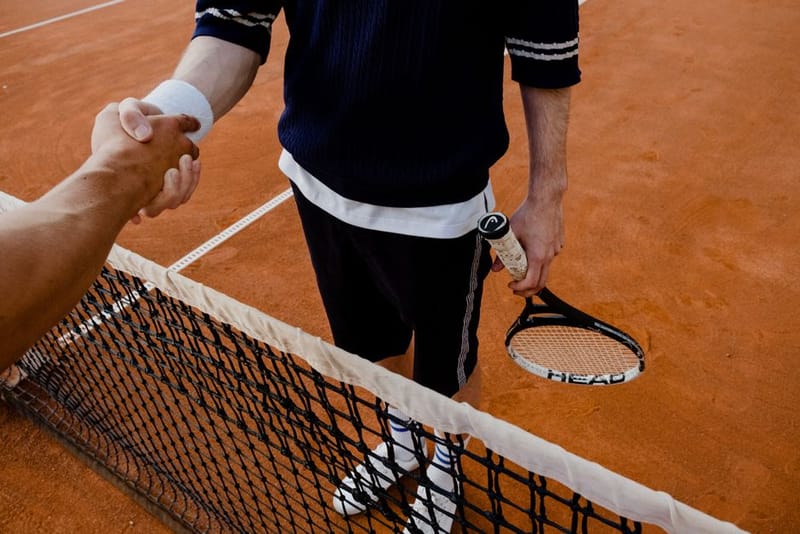
Tap rackets or shake hands at the net with all three other players after every match - including casual sessions. It's universal in racket sports and especially so in padel, where the doubles social structure depends on it.
Collect all the balls and stack them neatly at the back of the court or in their tube. The next group walking on shouldn't have to gather your stray balls. Most clubs sweep courts daily but expect players to leave them tidy.
Leave the court promptly when your time is up. The next booking starts on the hour, and standing on court chatting eats into someone else's time. Move the conversation to the lounge or terrace.
Report damage. If a ball gets stuck on the wires above the glass, the net is loose, or anything else is amiss, tell the front desk before you leave. Clubs depend on members to flag issues quickly.
What etiquette mistakes do UK padel beginners make?
Five recurring mistakes show up almost universally with newer players, and all five are easily fixed once they're pointed out.
Bringing more than one guest into the court area. Most UK clubs have strict 'players only on court' rules to avoid crowding the access corridors. Spectators wait in the lounge or watch from outside the glass.
Holding a long discussion mid-game. Strategy chats between points are fine; full coaching huddles every game slow the match and frustrate the other team. Keep it short - three to five seconds is the working norm.
Calling 'out' too loudly or too late. The call should be clear and immediate. A delayed 'out' after your opponent has already played a shot is unfair to both teams.
Hitting the next ball before everyone is ready. Wait for both opponents to be in position before serving. Quick-serving is technically legal but considered poor form at club level.
Asking opponents to call their own faults. Line calls on each side belong to the team on that side of the net. Don't pressure the other team to call against themselves - it's their job to be honest, and they will be if the culture of the club is set right.
Frequently asked questions
Who calls the score in padel doubles?
Is it rude to lob constantly in padel?
Do I have to shake hands after every match?
Can I walk behind a court during a point?
What do I do if my ball rolls onto another court?
Is it OK to coach my doubles partner during a match?
Should I call my own foot faults on the serve?
New to padel? Here's where to start
Our complete beginner guide covers court layout, rules, basic tactics, and the equipment you actually need.