Diamond vs Round vs Teardrop Padel Rackets: Which Shape
Padel racket shape - diamond vs round vs teardrop - changes the sweet spot and which shots feel natural. Which to pick by player level and style.
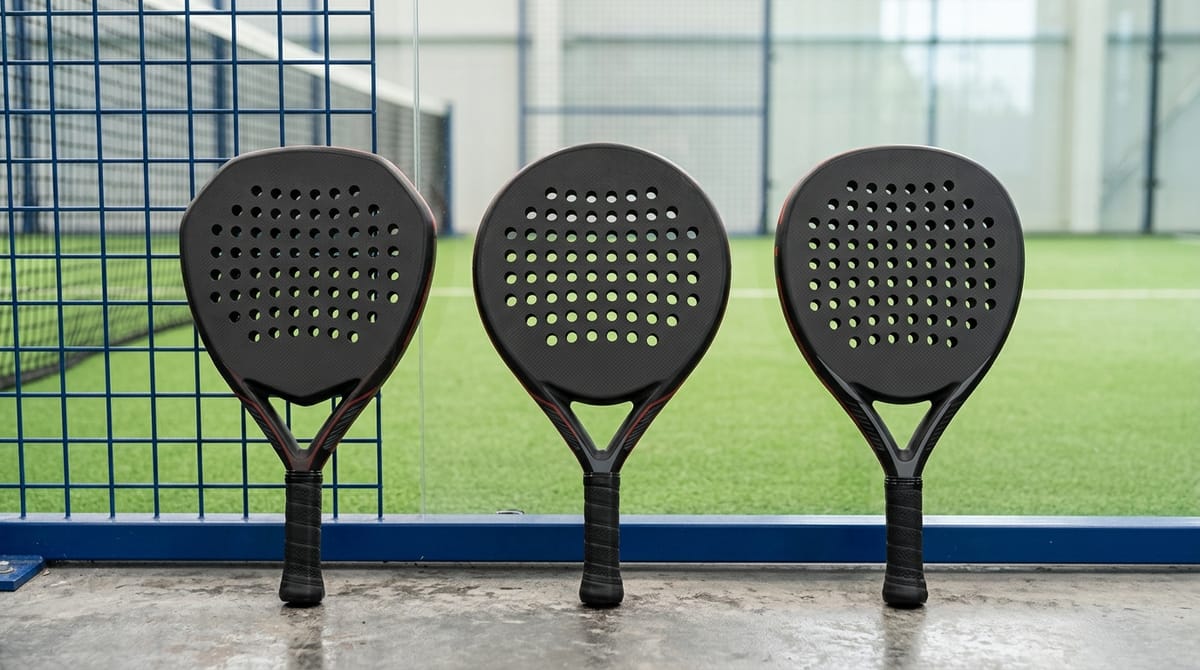
Padel racket shape is one of those specs that looks like marketing fluff and turns out to actually matter. The three head shapes - diamond, round, and teardrop - change where the sweet spot lives on the racket face and therefore which shots feel effortless and which feel awkward. Pair a diamond racket with a controlling beginner and the game gets frustrating fast. Pair a round racket with an advanced power player and the smash never lands. The right shape is the one that matches your level, your role on court, and the shots you most need to feel natural.
This guide walks through what each shape does, the physics behind why it works that way, and a decision matrix to pick the right shape for your level. It's deliberately shape-focused rather than a brand-by-brand listicle - for specific racket recommendations, see our best padel rackets buyer's guide and the best beginner rackets guide.
What do the three padel racket shapes look like?
Round, teardrop, and diamond - the visual and physical differences
All padel rackets are roughly the same overall outline - a perforated face about 45–46 cm long with a short grip and a strap. The differences are in where the mass is concentrated. The simplest way to see the three shapes is to look at where the racket is widest.
Head shape at a glance
- Round
- Widest at the centre of the face, narrows symmetrically toward the top and grip
- Diamond
- Widest at the top of the face, narrows toward the grip - top-heavy outline
- Teardrop
- Widest in the upper-middle of the face, gradual taper to the grip - pear-shaped
- Typical balance point (round)
- 240–265 mm from butt - head-light
- Typical balance point (teardrop)
- 265–275 mm - neutral
- Typical balance point (diamond)
- 275–290 mm - head-heavy
The balance point is the key physical measurement. It's the distance from the butt of the grip to where the racket would balance horizontally on a single point. A head-light racket (round) puts mass near your hand, which is faster to swing and easier to react with. A head-heavy racket (diamond) carries mass at the top of the face, which is slower to swing but generates more power on impact. Teardrop sits in between.
Where does the sweet spot sit on each shape?
The single most important consequence of head shape
Every padel racket has a sweet spot - a region of the face where impact transfers cleanly into the ball, vibration is minimal, and energy return is highest. Hit off-centre and the racket twists in your hand, the ball flies unpredictably, and your forearm absorbs the shock. The sweet spot's location and size are direct consequences of head shape.
Round rackets concentrate the sweet spot dead-centre on the face, and it's relatively large. Most contact zones - drives, blocks, lobs, defensive resets - land in or near the sweet spot regardless of where on the face you make contact. That forgiveness is why round rackets are the standard recommendation for anyone whose ball-striking isn't yet consistent.
Diamond rackets move the sweet spot up toward the top of the face, and shrink it. The sweet spot lines up with the highest impact zone on a smash, which is why advanced players who play offensive net positions favour diamonds - when you connect cleanly at the top of the face on a smash, the power is exceptional. The trade-off is that defensive shots, low volleys, and any contact made near the centre or lower face fall outside the sweet spot and feel mushy.
Teardrop rackets place the sweet spot in the upper-middle of the face - a useful compromise. The smash zone is in the right neighbourhood for power, but the centre of the face is still close enough to the sweet spot to handle defence and resets. For intermediate players who play full-court padel rather than fixed offensive or defensive roles, the teardrop is the most versatile choice.
When does a round padel racket make sense?
Control, forgiveness, and the entry-level standard
Round-shaped rackets prioritise control. The head-light balance makes the racket fast to swing, easy to manoeuvre on quick reactions at the net, and forgiving on touch shots like blocks, lobs, and chiquitas. The large central sweet spot means off-centre hits still go where you want them to go.
Round is what you want when you're learning padel and ball-striking is inconsistent - which is virtually everyone for at least the first six months of regular play. It's also what experienced control players continue to favour. Many top professional left-side players (the side that typically plays defence and sets up points) use round or near-round rackets even at the elite level.
The trade-off is power. A round racket will never generate the same smash velocity as a diamond, all else equal. Top-end attacking shots feel like they need extra arm to drive through. That's a real limitation if your role is to finish points at the net, but it's not a limitation that affects beginners or intermediate control players - both groups score most of their points from positioning and consistency rather than raw winners. If you want lighter, head-light picks chosen on weight and balance rather than gendered marketing, our best padel rackets for women UK guide applies exactly this logic.
When does a diamond padel racket make sense?
Power, smash specialisation, and the advanced player's tool
Diamond-shaped rackets are the power option. The head-heavy balance concentrates mass at the impact point on a smash and on overhead shots - when you connect cleanly, the racket does more of the work, and the ball leaves with serious velocity. Advanced offensive players, particularly right-side players (the attacking side in most pairings), favour diamonds for exactly this reason.
Diamonds are also the least forgiving shape in padel. The smaller, higher sweet spot means off-centre contacts feel terrible - vibration, twisting, and inconsistent ball direction. They demand consistent technique and clean ball-striking; if you don't have both, a diamond punishes you on every defensive shot, every reset, and every low volley. That's why pro coaches almost universally tell intermediate and below players to stay away.
Diamond rackets also tend to be the heaviest in the typical 370–380 g range. The combination of head-heavy balance and overall weight makes them physically demanding - wrist, elbow, and shoulder load is materially higher than with round or teardrop rackets, and tennis-elbow style overuse injuries are more common among diamond users who don't have the conditioning or technique to handle them.
When does a teardrop padel racket make sense?
The hybrid choice - and why it suits most players
Teardrop rackets are the all-rounder. They share the diamond's slightly head-toward balance, which gives them more smash power than a round, but the wider mid-face profile keeps the central sweet spot bigger and more forgiving than a true diamond. For intermediate players whose roles aren't strictly attacking or defensive, the teardrop is usually the right answer.
The teardrop is also the safest upgrade path from a round racket. A player whose technique has matured past the round's forgiveness can step up to a teardrop without giving up so much sweet-spot size that defensive play falls apart. By contrast, jumping straight from round to diamond is a common path to frustration - and to overuse injury when the heavier, less forgiving racket is paired with technique that hasn't quite caught up.
Which other factors affect racket choice?
Weight, balance, and core type
Shape is the headline spec but it's not the only one. Three other characteristics interact with shape and can amplify or partly cancel its effect.
Total weight (350–380 g typical)
Heavier rackets have more momentum but are slower to swing. Lighter rackets are faster but generate less raw power. A 360 g round racket and a 360 g diamond racket play very differently because of balance, even at the same weight. Most adult men play 365–375 g; most adult women play 355–365 g, with substantial individual variation.
Balance point (mm from butt)
More precise than 'head-light vs head-heavy' shorthand. A teardrop at 270 mm balance plays much more like a round than a teardrop at 280 mm. Always check the balance figure on the manufacturer's spec sheet - it's a more reliable predictor of feel than shape alone.
Core type - EVA vs FOAM
EVA cores are denser, more durable, and return more energy on impact - more power. Foam cores are softer, softer, and absorb more vibration - more control and less shock transmitted through the frame. EVA-soft sits in between. Most diamond rackets use EVA-hard; most beginner rounds use foam; teardrops typically use EVA-soft or medium.
Surface finish - rough vs smooth
Rough faces grip the ball longer at contact, generating more spin. Smooth faces release the ball faster, generating more raw power. The interaction with shape matters: a rough-faced diamond is a spin-and-power combination favoured by some modern attacking players; a smooth-faced round is unusual but suits flat-hitting control specialists.
Which racket shape suits which player?
Map player level and style to the right shape
Recommended head shape by player profile
- Complete beginner (0–6 months)
- ROUND - foam or EVA-soft core, 355–365 g, balance <265 mm
- Improving beginner (6–18 months)
- ROUND or light TEARDROP - EVA-soft, 360–370 g
- Intermediate control / left-side player
- ROUND or TEARDROP - EVA-soft or medium, 360–370 g
- Intermediate attacking / right-side player
- TEARDROP - EVA-medium, 365–375 g, balance 270–278 mm
- Advanced all-court player
- TEARDROP or light DIAMOND - EVA-medium or hard, 368–375 g
- Advanced offensive / smash-heavy player
- DIAMOND - EVA-hard, 370–380 g, balance 278–285 mm
- Player with elbow or shoulder issues
- ROUND or TEARDROP with FOAM or EVA-soft core - never DIAMOND
What mistakes do people make when buying by shape?
What to avoid
Assuming heavier = more power
Balance matters more than total weight for power output. A 365 g diamond will smash harder than a 380 g round.
Buying diamond as a beginner because it 'looks pro'
Visible at every UK padel club. The diamond will slow your technical development and increase injury risk. Stay round or light teardrop for at least the first 12–18 months.
Ignoring the core type
Two rackets of identical shape and weight can feel completely different depending on whether the core is foam, EVA-soft, EVA-medium, or EVA-hard. Try before you buy where possible - most UK padel clubs have demo rackets.
Switching shapes mid-season
Each shape requires slight technical adjustments - particularly at the swing path and contact point on smashes. Allow at least 8–12 sessions on a new shape before judging it.
Buying online without holding the racket first
Grip thickness, balance feel, and overall manoeuvrability matter. UK chains like Pure Padel and Slazenger Padel clubs typically have demo programmes - see our club guides. Padel Nuestro and Padel Reviews ship returnable demos if you're not near a club.
Frequently asked questions
Which is best - diamond, round, or teardrop?
Are diamond rackets more powerful?
What's the difference between teardrop and hybrid rackets?
Should I match my partner's racket shape?
How much does racket shape matter compared to skill?
Do round rackets exist at the professional level?
How long should a padel racket last?
What should beginners spend on their first racket?
Best Padel Rackets UK 2026: A Buyer's Guide
Best Padel Racket for Beginners UK 2026
Padel for Beginners UK 2026: The Complete Guide

Where to Play Padel in the UK: 2026 Guide
Sources: World Padel Tour and Premier Padel official racket regulations; manufacturer specification sheets (Bullpadel, Wilson, Adidas, Head, Babolat, Black Crown, Joma, Nox); LTA Padel pathway technical materials. This is an editorial gear-explainer, not regulated coaching advice. Always demo a racket before buying where possible - most UK padel clubs run demo programmes. Last reviewed 11 May 2026.