How to Serve in Padel: The Complete Underarm Guide
The padel serve is underarm-only and almost never wins points outright. The complete guide to rules, mechanics, serve types, and common beginner mistakes.
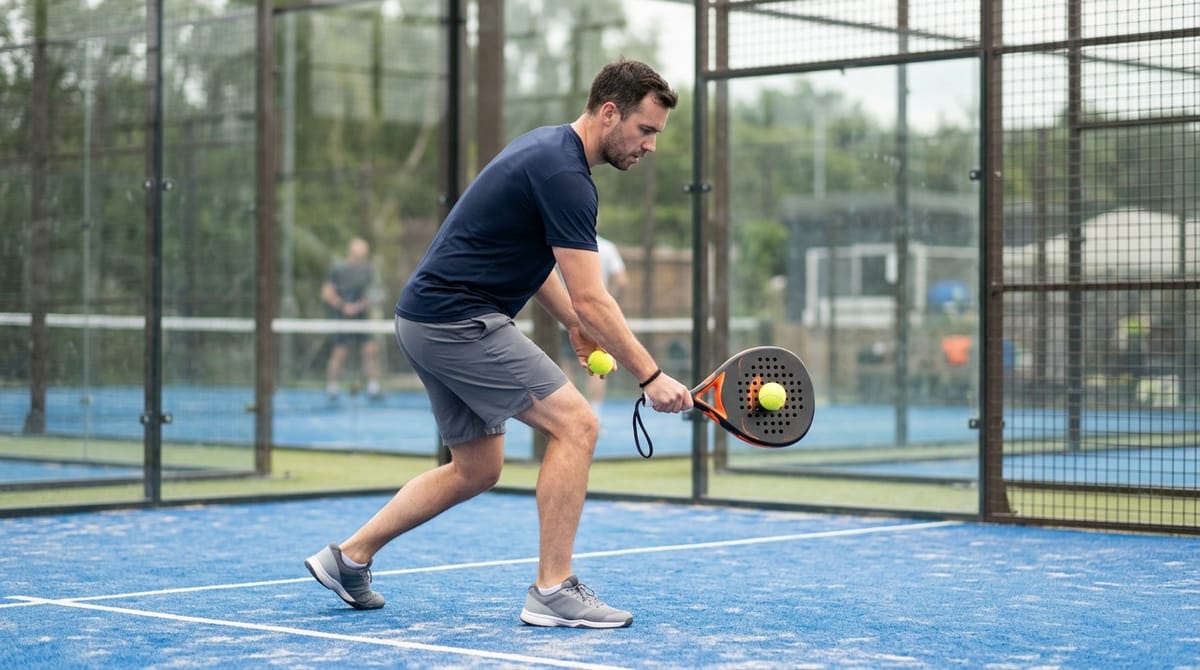
Learning how to serve in padel takes about a session to get legal and about a season to do well. The serve is underarm only, the ball must bounce in your own service box before you hit it, and unlike tennis, the point of a padel serve is almost never to win the point outright - it's to set up the rally on your terms. This guide walks through the rules, the mechanics, and the four common serve types, with the beginner mistakes that cost the most points.
What are the padel serve rules in 60 seconds?
Before mechanics, the rules. A serve in padel is legal only if all of the following are true.
You stand behind the service line with both feet inside your service box quadrant - neither foot can touch or cross the service line, the centre line, or the side line during the serve action. You drop the ball (not toss) and let it bounce on the floor inside the service box. You strike the ball after the bounce, with the racket below waist height - striking above the waist is a fault. The ball must clear the net, land in the diagonally opposite service box, and not touch your own side glass or wires before clearing.
From there, normal padel rules apply: the receiver lets the ball bounce once before returning. If the ball clips the net cord and lands in the correct box, it's a let - replay the serve, no fault charged. If it clips the cord and goes anywhere else, including hitting the side glass on the receiver's side, it's a fault. As with tennis, you get two serves per point; two faults in a row is a double fault, and the receiving team wins the point. Full rules are covered in our padel rules guide - this article focuses purely on the serve itself.
How do you hit a clean underarm padel serve?
Take your stance behind the service line
Side-on to the net, feet shoulder-width apart, weight on the back foot. Both feet behind the service line, both inside your quadrant. Most players stand about 30-60cm behind the service line - close enough to drive the serve, far enough to avoid foot faults.
Hold the ball at waist height in your non-racket hand
The drop must be a controlled release, not a toss. Holding the ball at waist height and releasing means it falls to your strike zone naturally. Tossing higher risks an above-waist contact, which is a fault.
Release the ball forward and slightly to your racket side
Let it fall in front of your front foot, drift right (for right-handers) toward where the racket head will pass. The ball should hit the floor 30-50cm in front of you.
Let the ball bounce once and rise to between knee and waist
Strike it at the top of its rise, when it's between knee and waist height. Contact above the waist is a fault - when in doubt, hit lower.
Strike with a smooth, controlled swing through the ball
Bring the racket forward at roughly hip level, contact in front of your front foot, follow through low and through to your target. This is a placement shot - pace comes from clean contact, not from a big swing.
Repeat the sequence on the second serve, even if you don't switch types. Consistency on the second serve is more valuable than variety - a double fault is the worst possible outcome of a service game and entirely self-inflicted.
What are the four main padel serve types?
Padel has four serve types that come up regularly at club level. None of them are intended to win the point on the serve alone. They are setup shots designed to make the return predictable and weak, so your team can dominate the net.
Serve types and when to use them
- Slice serve (most common)
- Side spin makes the ball skid wide off the side glass - the standard club serve
- Flat serve
- Straight, mid-paced, into the body - useful as a change-up to break rhythm
- Topspin serve (kicker)
- Heavy forward spin makes the ball jump up after the bounce - best on slow courts
- Body serve
- Aimed at the receiver's hip to cramp their swing - varies pace, used sparingly
The slice is the workhorse serve in padel. A right-handed player serving from the deuce side (their own right-hand quadrant) hits with sidespin so the ball curves toward the receiver's backhand side glass after bouncing - making for an awkward return off the glass that bounces low and away. The mirror image works from the advantage side. If you only learn one serve, learn the slice.
The topspin or kick serve gets less use than in tennis because the slower padel ball doesn't generate as much bounce, but it shines on slower indoor courts or in cold weather when the ball is less lively. The flat serve and body serve are pattern-breakers - used occasionally to keep the receiver from camping on your favourite slice angle.
What should you do on your second serve?
The second serve is the most undervalued shot in club padel. The temptation after a first-serve fault is to hit a softer, safer version of the same serve. The better instinct is to hit a deliberately different serve - usually a slow flat serve into the receiver's body - that has near-zero fault risk.
Why? Because a double fault is the worst possible result in padel. You give up the point unforced, and your team loses the rally before it starts. The marginal value of a slightly more aggressive second serve is small; the cost of a double fault is enormous. Most professional players take a noticeable amount of pace off their second serve precisely because the variance reduction is worth more than the lost pace.
A useful rule: if you'd estimate your first-serve in rate at 65% and your aggressive-second-serve in rate at 75%, your effective hold rate is similar to or worse than using a 95%-in second serve, because the points lost to double faults outweigh the slightly easier returns. The math, much like fractional Kelly in bet sizing, favours volatility reduction over expected aggressiveness.
What are the common beginner serve mistakes?
Most beginner serves go wrong in five recognisable ways, all of them fixable in a session of drilling.
Striking above the waist. The most common foot fault is actually a height fault. Players who came from tennis instinctively let the ball rise to chest height before striking. In padel, that's a fault. Forcing yourself to make contact at hip height feels wrong at first and is essential.
Drifting feet across the service line. The serve action is a forward motion, and feet creep across the line without you noticing. Practise serving with a focus on staying anchored - your hitting motion should be a swing through the ball, not a step into it.
Tossing the ball instead of dropping it. Letting the ball fall from waist height is more consistent than any kind of toss. A toss adds a variable (release height, angle, timing) that compounds with the strike - drop and strike at the top of the bounce instead.
Hitting too hard. Padel courts are small (10m × 20m), and a heavy serve gives the receiver more time and angle on the return because the ball comes off the back glass cleanly. Mid-paced placement serves produce more chaotic returns than power serves at club level.
Not coming to the net. The serve is the cue for the serving team to advance to the net. Standing back after the serve concedes the strongest court position in the sport. Hit, recover one step, and move forward as a pair as soon as the receiver's return is read.
Which drills build a reliable padel serve?
Three drills cover the bulk of serve practice that pays off in real matches.
The cone drill. Place a cone in each corner of the diagonal service box - left back, right back, body. Serve ten balls aimed at each cone in sequence. The point is not to hit the cone but to commit fully to the target. Most club players have a default serve direction and never practise the other two - this drill cures that.
The fault-free drill. Serve thirty balls in a row with the only goal being no faults. Use whatever serve type, pace, or placement keeps the percentage at 100%. This builds the second-serve muscle memory that matters more than first-serve power.
The serve-and-advance drill. Have a partner stand at the service line opposite. You serve, they hit a basic return, and you must take the first volley from inside the service line. This builds the habit of moving forward as part of the serve, which most beginners skip.
How do you pick the right padel serve tactically?
The right serve depends less on aesthetics than on what the receiver has shown they cannot handle. A few patterns are worth knowing.
Against a receiver standing close to the service line, a slice serve wide forces them to move and react to glass - generally producing a weak return. Against a receiver standing deep, a topspin serve up the T (centre line) cramps their swing space because the ball jumps into their body. Against a partnership where one player is clearly weaker, serve to that player most points, especially on big points.
The general rule: identify the receiver's weakest stroke, then ask which serve type most reliably produces that stroke. A backhand returner who struggles with low balls gets slice serves into their backhand glass. A forehand returner who jams on high balls gets topspin serves into their body. The serve choice is a tactical decision, not a habitual one.
Frequently asked questions
Can you serve overarm in padel?
Where exactly is 'waist height' on the padel serve?
Does the ball have to bounce before I serve it?
What happens if my serve hits the side glass after landing in the service box?
Should I serve hard like in tennis?
How do I stop double-faulting?
What's the difference between a fault and a let on the serve?
New to padel? Start with the fundamentals
Our complete beginner guide covers court layout, rules, basic tactics, and the equipment you need to start playing.