Padel Doubles vs Singles Format UK 2026
Padel doubles vs singles UK 2026: court differences, rules, fitness demands, where to play singles in the UK.
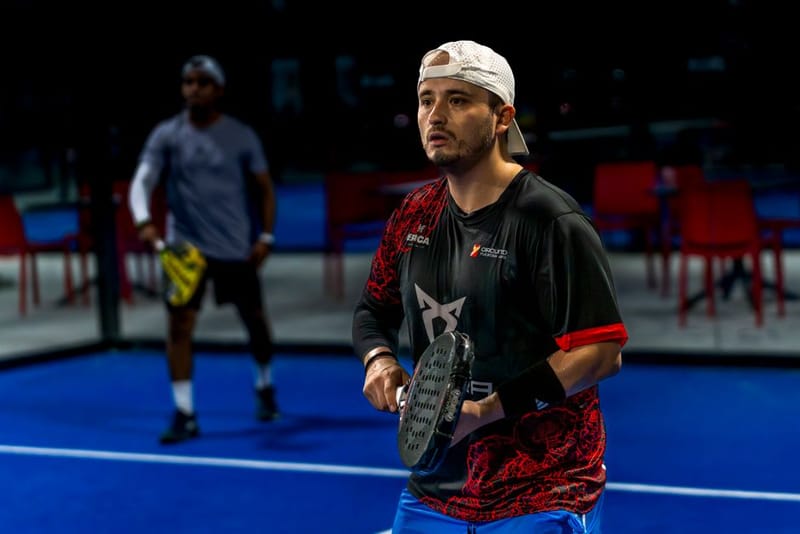
Padel singles is rare in UK 2026 - the entire competitive ecosystem is doubles-only. This guide covers when singles exists, why doubles dominates, and what each format requires.
Why padel is doubles-only by default
The sport's design rationale.
Court geometry favours doubles:
- 20m × 10m court = 200m2 playable.
- One player covers ~100m2; in doubles each covers ~50m2.
- Singles play feels like covering a small tennis court alone - exhausting + impractical.
The sport's evolution:
- Padel originated in Mexico (1969) + popularised in Spain + Argentina.
- Spanish + Argentine clubs adopted doubles as standard from the early days.
- By the time padel professionalised (World Padel Tour 2013), doubles was the established format.
- UK adoption (2018+) inherited the doubles-only convention.
Rule + court design optimised for doubles:
- Service rules + return positioning assume 2 players per side.
- Wall play is more strategic with doubles partnership.
- Match scoring + format designed for doubles dynamics.
Doubles padel - the standard format
What 99%+ of UK play is.
Court + setup:
- Court: 20m × 10m (66ft × 33ft).
- Net: 88cm at posts, 92cm at centre (lower than tennis 91.4/107cm).
- Walls: glass back walls (3m+ tall) + mesh side walls.
- Service line: 7m from net (closer than tennis 6.4m).
Format:
- 2 players per side (2v2).
- Match: best of 3 sets typical.
- Set: first to 6 games; tiebreak at 6-6.
- Game: standard tennis-like scoring (15-30-40-game).
- Match duration: 60-90 min typical.
Strategic positioning:
- Both players at net (most common attacking position).
- One at net, one at baseline (defensive transition).
- Both at baseline (early-rally defensive).
- Lefty + righty pairing covers court middle most efficiently.
Singles padel - the rare format
When + where it happens.
How singles padel differs from doubles:
- Players: 1v1 instead of 2v2.
- Court coverage: each player covers full 100m2 (vs 50m2 doubles).
- Rally length: longer (5-12 sec vs 3-7 sec doubles).
- Energy system: more aerobic; less explosive than doubles.
- Strategy: more like tennis - groundstroke rallies, court positioning.
Where singles is played:
- Some specialised clubs: a handful of UK clubs offer dedicated singles courts (typically smaller dimensions).
- Self-organised matches: friends arranging singles play on standard courts (suboptimal but workable).
- Training context: coaches use singles drills for individual development.
UK clubs offering singles padel: very few. Best to call ahead. Most Pure Padel + LTA padel clubs don't support it as a regular format.
Why singles isn't catching on:
- Fitness demands are very high; most UK club players are not at that level.
- Court size optimised for doubles; feels too big for singles play.
- No competitive ecosystem (no World Padel Tour singles category for elite players).
Fitness demands compared
Why singles padel is more demanding.
Doubles padel fitness requirements:
- Anaerobic-alactic (short bursts, 3-7 sec rallies).
- Lateral agility critical.
- Reaction time at net.
- Moderate aerobic capacity.
- Typical 'fit recreational' player can sustain doubles play.
Singles padel fitness requirements:
- Anaerobic-alactic + sustained aerobic.
- Twice the court coverage per player.
- Longer rallies (5-12 sec) = sustained effort.
- Less recovery between points (no partner to share work).
- Typical 'fit recreational' player struggles after 30 min of singles play.
Energy system shift:
- Doubles: 70% anaerobic / 30% aerobic.
- Singles: 50% anaerobic / 50% aerobic.
- Singles closer to tennis singles fitness profile.
Rule differences
Where format affects play.
Doubles padel rules (standard):
- Serve diagonally (deuce/advantage side alternates).
- Server changes after each game.
- Service from behind service line, between centre line + side line.
- Ball played off back walls + side walls (own court only) - wall play is legal + strategic.
Singles padel rules:
- Same court + walls.
- Service rules unchanged.
- Wall play still legal + critical.
- One player serves all games (no partner alternation).
- Server can serve from either side; receiver returns to either side.
Scoring:
- Identical in both formats: 15-30-40-game; first to 6 with tiebreak at 6-6.
- Match: best of 3 sets standard for both.
Recommendation by player goal
Doubles or singles?
If you want to play in UK tournaments / leagues / competitive ladders: doubles only. The entire UK competitive ecosystem is doubles.
If you want to enjoy social padel + meet new partners: doubles only. UK club culture is doubles-organised.
If you want maximum cardiovascular workout: singles, but you'll struggle to find venue + opponent.
If you want a singles-style racquet sport in UK: tennis (mature ecosystem); padel-tennis (rare, growing); pickleball (singles + doubles, growing fast).
If you're a former tennis singles player frustrated by doubles-only padel: try a different racquet sport for singles. Padel won't fit your preference.
Other padel format variations
Beyond doubles + singles.
Padel-Tennis (Argentine origin):
- Smaller court (18m × 9m).
- Often singles-friendly.
- Different walls/rules.
- Rare in UK; growing slowly.
American Padel:
- Uses standard 20m × 10m court.
- Some rule variations (no walls in some formats).
- Very rare in UK.
POP Tennis / Paddle Tennis (US):
- Often confused with padel but is a different sport.
- Smaller court, no walls, perforated paddles.
- Not the same as UK padel; not part of UK padel ecosystem.
Open Padel (informal recreational):
- Some UK clubs run 'open court' sessions where players arrange any format (doubles, singles, mixed).
- Best way to find singles play in UK if interested.