Padel vs Pickleball UK: Which Is Right for You?
Padel vs pickleball in the UK in 2026: how the courts, rackets, scoring and growth trajectories differ - and which sport suits new players better.
In the UK in 2026 the padel-vs-pickleball question already has a clear scoreboard answer: padel is the larger sport by a wide margin (around 559 courts at last LTA count) and pickleball is the faster-growing one off a much smaller base (in the low hundreds of UK venues). They look superficially similar - short racket, low net, doubles-friendly - but the two play very differently, cost differently, and reward different kinds of player. This guide pulls them apart so you can pick the one that suits you.
How do padel and pickleball courts differ?
The court is the single biggest difference between the two sports. A padel court is fully enclosed - 20 metres by 10 metres with 3-metre glass back walls and metal-mesh side fencing. The ball stays in play after it hits any of those walls, which is the source of padel's longer rallies and its distinctive tactical pattern (lob over the opponent → wait for the wall bounce → attack the rebound).
A pickleball court is open and much smaller: 44 feet by 20 feet (13.4 m × 6.1 m), the same dimensions as a doubles badminton court. There are no walls. There is a 7-foot "kitchen" - a non-volley zone - either side of the net that you cannot volley from. The kitchen is what stops the sport degenerating into a smash-fest at the net.
Court dimensions and key features
- Padel court size
- 20 m × 10 m, fully enclosed
- Pickleball court size
- 13.4 m × 6.1 m (44 ft × 20 ft), open
- Padel walls
- Yes - glass back walls + metal-mesh sides, ball stays in play off the walls
- Pickleball walls
- None
- Padel net height
- 0.92 m at centre, 0.88 m at the posts
- Pickleball net height
- 0.86 m at centre, 0.91 m at the posts
- Pickleball non-volley zone
- 7 ft (2.13 m) either side of the net (the "kitchen")
- Padel non-volley zone
- None
How are padel rackets and pickleball paddles different?
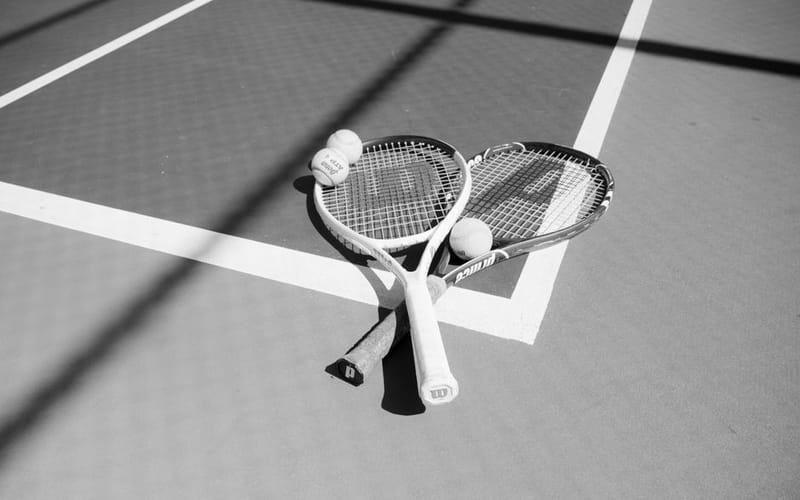
Both sports use a solid striking surface - there is no strung racket in either - but they're built for different jobs. A padel racket is shorter than a tennis racket, has a perforated face (typically 9–13 holes plus a series of smaller cosmetic ones), and weighs roughly 350–390 g. The perforations matter: they reduce aerodynamic drag during the high-speed swings padel rewards, which is why solid-face copies don't play well.
A pickleball paddle is smaller again (about 8 inches wide × 16 inches long), lighter (roughly 200–240 g) and flat-faced. It's designed for control over power - the ball is a perforated plastic Wiffle-style sphere weighing about 22–26 g, so there isn't much to hit hard. Modern pickleball paddles use carbon-fibre faces with thermoformed edges, but the spirit of the design is the same: precision placement on a slow ball.
For padel racket shapes (diamond / round / teardrop) and how to pick one, see our padel racket shape guide.
How does a padel rally compare to pickleball?
Padel is fast. The ball is a slightly de-pressurised tennis ball travelling at near-tennis speeds, and the walls keep rallies alive far longer than they would be on an open court. Average rallies in club-level doubles tend to run 8–15 shots; in competitive matches they can run much longer because the lob-and-wall pattern resets the point. The cardiovascular load on a beginner is closer to squash than to tennis.
Pickleball is slower - by design. The plastic ball decelerates quickly after each bounce, the kitchen prevents both teams parking themselves at the net, and rallies tend to settle into a "dink" pattern where soft shots cross the net at low pace until someone over-commits. The cardio load is lower, the joint impact is lower, and that is why the sport has spread so quickly in older demographics in the US.
Neither sport is intrinsically easier to start - both reward existing racket-sport instincts - but pickleball has a flatter learning curve to "playing competent rallies" because the ball is slower and the court is smaller. Padel takes a few sessions before the wall geometry stops surprising you.
How do the two scoring systems differ?
Padel uses tennis scoring almost verbatim - 15, 30, 40, game; deuce and advantage; best of three sets with a tiebreak at 6-all. The only major variant is the "Golden Point" rule used at FIP/Premier Padel level: at deuce, the next point decides the game (no advantage). UK club play has gradually picked up Golden Point since 2024 to keep matches predictable in length.
Pickleball traditionally uses side-out scoring - only the serving team can score, games go to 11 (win by 2), and the server number alternates after each fault. From 2025 onwards, rally scoring (every rally scores, games to 21) has been trialled in tour-level events and is slowly filtering into recreational play. Most UK clubs in 2026 still use side-out for casual sessions and rally scoring for ladders.
Scoring at a glance
- Padel game scoring
- 15-30-40-game (tennis scoring)
- Padel set/match
- First to 6 games (win by 2 or tiebreak at 6-6); best of 3 sets
- Padel deuce rule
- Advantage scoring or "Golden Point" (sudden death) depending on competition
- Pickleball game scoring
- Side-out to 11 (win by 2), or rally scoring to 21
- Pickleball match
- Best of 3 games (recreational) or best of 5 at higher levels
- Pickleball serving
- Underhand only, below the waist, diagonal to the opponent's service box
How big are padel vs pickleball in the UK in 2026?
The two sports are growing at different speeds off different bases. The LTA's 2025 padel infrastructure report counted around 559 courts in the UK, with a growth trajectory aiming at 1,000 by the end of 2027. Pickleball England's 2025 venue list ran to roughly the low hundreds of dedicated and shared venues, with pickleball typically played on temporarily-marked badminton or tennis courts rather than dedicated facilities.
The geographic distribution looks different too. Padel is concentrated in London (where Padel courts in London alone outnumber pickleball venues in the entire south-east), Manchester, Birmingham, Edinburgh and Glasgow, with operators like Pure Padel and Padel Social Club building out branded chains. Pickleball is more evenly spread because it can be rolled into existing badminton clubs - the marginal cost of "adding pickleball" to a leisure centre is a few rolls of tape and a portable net.
Both sports are growing rapidly. WPN Padel's Global Search Report 2026 put the UK in the top three padel-search-growth markets worldwide; Pickleball England membership roughly doubled in 2025. The relevant question for a new player isn't "which sport is bigger" but "which one can I actually play near me".
What does each sport cost to start?
Pickleball is cheaper to start, by some distance. A starter paddle costs £20–£40, balls are sold in packs of three for under £10, and many UK clubs run pay-as-you-play sessions at leisure-centre rates (£3–£6 per person for an hour). Padel court hire runs £24–£40 per hour for the court, split four ways - so £6–£10 per player - and a starter racket runs £50–£120.
Typical UK cost to get started (2026)
- Padel starter racket
- £50–£120
- Pickleball starter paddle
- £20–£40
- Padel ball tube (3 balls)
- £5–£8
- Pickleball ball pack (3 balls)
- £6–£10
- Padel court hire (per hour, split 4 ways)
- £6–£10 per player
- Pickleball pay-and-play session
- £3–£6 per player
- Padel coaching (group)
- £15–£25 per session
- Pickleball coaching (group)
- £8–£15 per session
The numbers above assume mid-range kit. If you want to go cheaper still, most UK padel clubs offer beginner taster sessions with rackets and balls included for £10–£20; most pickleball venues will lend you a paddle for the price of a session. Trying both before committing to kit is almost universal advice from UK coaches.
Padel or pickleball - which should you try first?
The most reliable filter is geography. Both sports reward repetition, and the sport you can play three times a week is the one you'll get good at. Open the LTA's club finder and Pickleball England's venue map side by side, plot your nearest five of each, and pick the sport with the better drive time.
If both are equally accessible, the choice comes down to the kind of rally you enjoy. Padel rewards anticipation, lobbing and counter-attacking off the walls; it punishes flat hitters and rewards anyone with squash or doubles-tennis instincts. Pickleball rewards patient placement, soft hands at the net, and a willingness to grind out long dinking rallies; it punishes anyone who tries to muscle a slow ball.
Demographically: padel skews 25–45 and slightly male-leaning in UK club rolls; pickleball is more evenly spread across ages and currently slightly older on average. Neither is exclusive of any age - and many UK leisure centres now run mixed sessions where both sports are available.
Frequently asked questions
Is padel just pickleball with walls?
Which is easier to pick up?
Can I play padel with a pickleball paddle (or vice versa)?
Why is pickleball so much bigger in the US than the UK?
Will UK padel courts overtake pickleball venues this decade?
Trying padel first?
Our complete UK beginner's guide covers rules, kit, your first session, and the LTA pathway from grade 5 to 1.