Padel for Seniors Over 50 UK 2026
Padel for over-50s UK 2026: physical adaptations, injury prevention, recommended rackets, senior leagues + UK clubs.
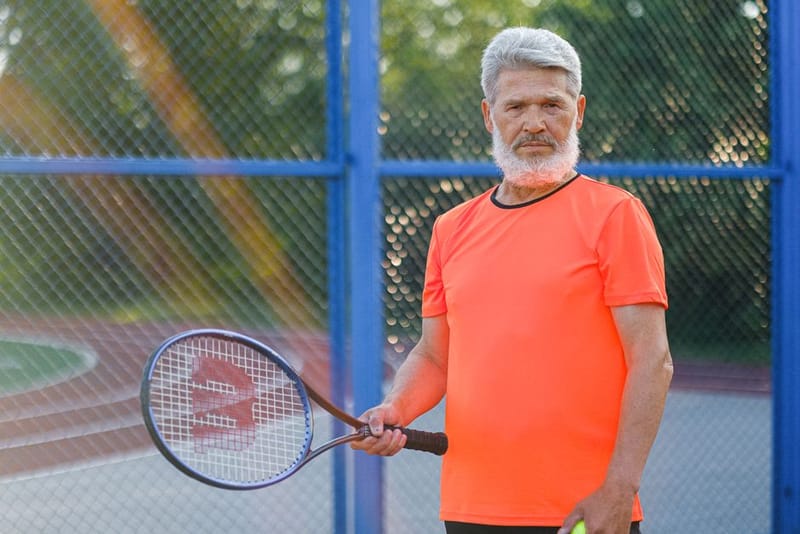
Padel is one of the few racquet sports where you can start fresh at 60+ and reach a competitive level within a year. This guide covers how to do it safely + where to find UK senior padel communities.
Why padel works for over-50s
Specifically vs tennis or squash.
Court geometry advantages:
- Padel court: 20m × 10m (doubles only).
- Tennis court: 24m × 11m (singles), 24m × 11m (doubles).
- Squash court: 9.75m × 6.4m.
- Padel court covered area per player: ~50m2 (vs tennis ~70m2 doubles). Less court coverage = less running per point.
Ball + paddle mechanics:
- Padel ball: 56-59g (vs tennis 58-59g - similar, but slower in flight due to less compression).
- Padel racket: 350-380g (vs tennis 280-330g) - heavier BUT shorter (44-46cm vs tennis 68cm), so leverage + grip stress lower.
- Padel racket head smaller (max 26cm width) = less arm rotation per stroke.
Rule advantages:
- Doubles-only format - 50% less individual court coverage than singles.
- Ball plays off back glass + side walls - reduces deep-court chasing.
- Underhand serve (vs tennis overhand) - dramatically reduces shoulder strain.
- Soft game (dinks at net) rewarded by rules.
Adapting your game for 50+
Five smart adjustments.
- Choose lighter racket (350-365g): less arm fatigue across long sessions. Avoid heaviest power rackets (375-395g).
- Favour bandeja + globo over smashes: bandeja (medium-high overhead with topspin) + globo (defensive lob) reduce rotator cuff strain vs flat smashes.
- Doubles partner with complementary fitness: pair with someone slightly more mobile to cover court positions where movement matters.
- Don't chase impossible balls: at 50+, the risk-reward of stretching for a low ball isn't worth a torn calf. Let some balls go.
- Warm up properly (10+ min): see injury prevention guide for routine.
Top injury risks for 50+ padel players
Prevention focus.
1. Rotator cuff strain (#1):
- Cause: overhead smashes + repeated overhead shots.
- Prevention: avoid smashes; rotator cuff strengthening 2-3x/week; warm up shoulders before play.
- Recovery: 4-12 weeks; often requires physio.
2. Calf strain:
- Cause: sudden lateral movements + sprint-stops on hard courts.
- Prevention: 10-min warm-up; calf-strength exercises; padel-specific lateral training.
- Recovery: 2-6 weeks.
3. Wrist strain:
- Cause: heavy racket + repetitive wrist motion + technique flaws.
- Prevention: lighter racket (350-365g); proper grip technique (don't grip too tight); wrist support if previously injured.
- Recovery: 4-8 weeks.
4. Knee strain (meniscus tears):
- Cause: sudden direction changes + lunging on hard courts.
- Prevention: proper court shoes; knee braces if previously injured; gradual progression.
- Recovery: 2-16 weeks depending on severity.
5. Achilles tendon:
- Cause: repeated sprinting starts; calf overload.
- Prevention: gradual progression; warm-up; cross-training (cycling, swimming).
- Recovery: 6-12 weeks for tendinitis; longer for ruptures.
Recommended equipment for 50+ players
Racket + shoes + accessories.
Racket (most important):
- Weight: 350-365g (lighter end). Examples: Bullpadel Vertex Control (355g), Babolat Air Veron (358g), Adidas Adipower Control 3.2 (355g).
- Shape: ROUND (control/even-balance, reduces wrist torque).
- Surface: Carbon 3K or fibreglass (softer feel than 12K+).
- Budget: GBP 100-180 typical mid-range. Avoid heavy power rackets (Adidas Metalbone, Head Delta Pro - too head-heavy for senior arm comfort).
Shoes (second-most important):
- Padel-specific or court tennis shoes (lateral support).
- AVOID running shoes (no lateral support = ankle roll risk).
- Examples: K-Swiss BigShot, Wilson Rush Pro 4, ASICS Solution Speed.
- Budget: GBP 80-130.
Other accessories:
- Knee brace (if previous injury): GBP 15-50.
- Compression sleeves (calf): GBP 8-20.
- Sweatbands (wrist + headband): GBP 10-15 set.
- Eye protection (optional, recommended for very competitive play): GBP 25-65.
UK senior padel leagues + venues
Where to play.
LTA Padel Senior divisions:
- 50+ + 60+ age divisions at national + regional tournaments.
- Beginner-friendly entry levels.
- LTA membership required; affiliated clubs only.
- Find tournaments: lta.org.uk/padel.
UK Padel National Senior Championships:
- Annual UK Padel event; senior divisions integrated.
- Spectator + entrant access.
- Search ukpadel.com for current schedule.
Pure Padel clubs (UK-wide):
- Multiple locations: Manchester, Birmingham, Leeds, Newcastle, London + more.
- Dedicated senior coaching programmes.
- Find local club: purepadel.co.uk.
Roman Way Padel + similar regional clubs:
- Many UK regional clubs run senior-only weekly sessions.
- Lower-pressure, social atmosphere.
- Find via Padel Atlas UK club directory.
U3A padel groups:
- Some U3A groups (50+ themed) include padel sessions.
- Recreational + social rather than competitive.
- Find local U3A: u3a.org.uk/find-a-group.
Community + leisure centre programmes:
- Padel slowly expanding to UK leisure centres.
- Check local council leisure listings.
Skill progression - realistic 50+ timeline
What to expect over a year.
Months 1-3 (Foundation):
- Learn rules + basic strokes (groundstrokes, volleys, basic overheads).
- 2 sessions/week recommended (1.5 hrs each).
- 1-2 lessons with a coach.
- Goal: rally consistently with intermediate doubles partner.
Months 4-9 (Development):
- Learn wall play (back wall, side walls).
- Develop bandeja + globo shots.
- 2-3 sessions/week.
- Goal: comfortable competitive doubles at intermediate level.
Months 10-12+ (Competitive):
- Tactical understanding (lobs, drops, positioning).
- 3-4 sessions/week if pursuing competition.
- Enter local senior tournament.
- Goal: regional senior tournament participation.
Long-term (Year 2+):
- Consistent improvement + tournament play.
- Many UK 50+ players reach competitive intermediate level (LTA rating 5-6) within 18-24 months.
Health benefits documented
Why playing is worth the effort.
Health benefits of padel for 50+ players (research from UK + Spanish sports medicine):
- Cardio fitness: moderate-intensity activity meets weekly NHS recommendation of 150min/week.
- Balance + fall prevention: lateral movement training reduces fall risk in 60+ players.
- Bone density: weight-bearing activity helps maintain bone density.
- Reaction time: doubles play with fast volleys trains reaction time - cognitive benefit.
- Social engagement: doubles format + club community reduces isolation.
- Mood + mental health: 1.5-hr sessions improve mood for 24-48 hrs post-play.