Padel String Tension Explained UK 2026
Padel string tension UK 2026: tension matters less in padel than tennis - here's what does affect power vs control.
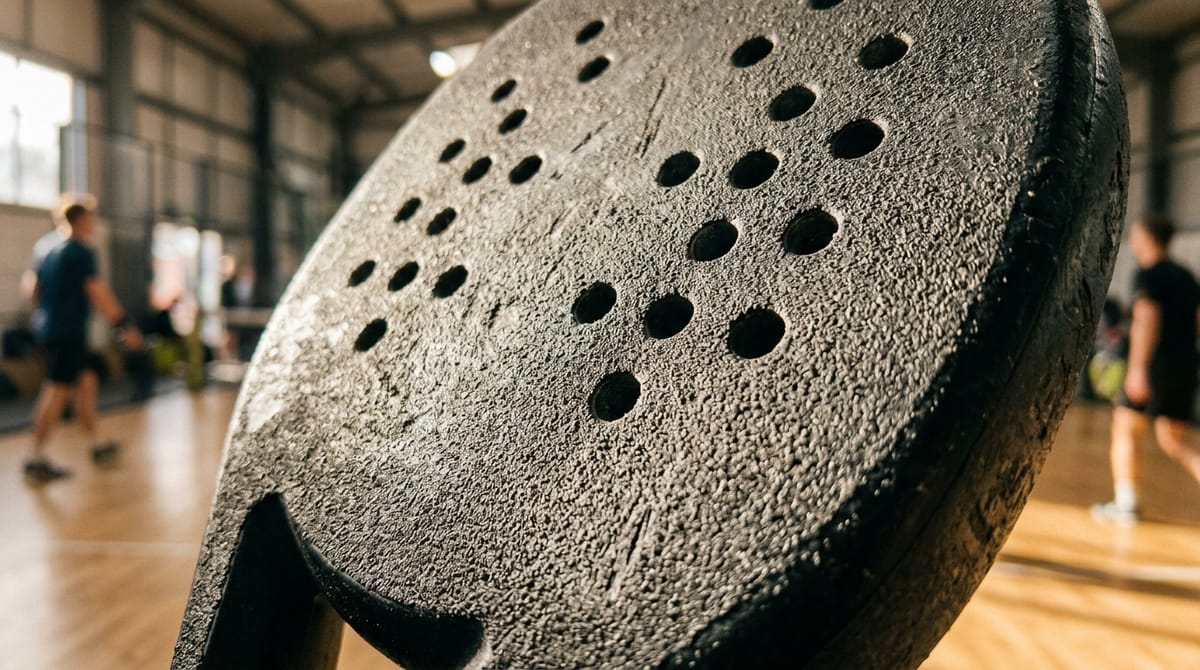
Most padel-curious tennis players assume rackets have adjustable string tension. They don't. This guide explains what actually drives padel racket feel + how to choose accordingly.
Padel rackets are not stringed
The fundamental difference from tennis.
Tennis rackets use a stringed mesh (16-18 main strings × 18-20 cross strings) at adjustable tension (typically 21-30 kg). Padel rackets are completely different:
- Solid perforated foam core: 13-19mm thick foam (EVA - ethylene vinyl acetate) with strategically-drilled holes (varies by model, ~8-20 holes total).
- Carbon/glass fibre face: 1-3mm composite surface covering the foam.
- No strings, no tension adjustment: the racket arrives + plays as manufactured. No 'restringing' service exists.
This means:
- You choose racket FEEL at purchase, not adjustment.
- 'Restringing' isn't a thing - if you damage the racket, you replace it.
- Cost economics differ - tennis restringing every 3-6 months costs GBP 15-40; padel rackets last 12-24 months until they need full replacement.
What drives padel racket feel - 3 key variables
The 'tension equivalent' factors.
1. Foam density (EVA hardness):
- Soft EVA (~70-75 shore A): plush feel; ball stays on racket longer; generates more power on full swings; less control for touch shots. Beginner-friendly.
- Medium EVA (~75-80 shore A): balanced feel. Most recreational rackets.
- Hard EVA (~80-85 shore A): crisp feedback; ball leaves quickly; better control; more demanding on technique. Pro / advanced players.
2. Surface material:
- Fibreglass: softest surface; control-oriented; entry-level rackets (sub-GBP 100). Forgiving for beginners.
- Carbon 3K: most common surface; balanced power + control. Used in GBP 100-200 rackets.
- Carbon 12K: stiffer, more powerful, more demanding on technique. GBP 150-250.
- Carbon 18K / 24K: maximum stiffness; pro-level rackets; rewards strong technique. GBP 200-300+.
3. Frame shape (separately covered in our shape guide):
- Diamond: most power, head-heavy bias.
- Teardrop: balanced.
- Round: most control, even-balanced or handle-heavy.
Choosing 'control' or 'power' feel by spec
The tennis-tension equivalent.
If you want a CONTROL feel (tennis equivalent: HIGH tension 28-30 kg):
- Round frame shape.
- Hard EVA core (80+ shore A).
- Carbon 12K or higher surface.
- Lighter overall weight (350-365g).
- Examples: Bullpadel Vertex 04 Control, Adidas Adipower Control 3.2, Babolat Counter Veron.
If you want a POWER feel (tennis equivalent: LOW tension 23-25 kg):
- Diamond frame shape.
- Soft EVA core (70-75 shore A).
- Carbon 3K surface (or fibreglass for entry).
- Heavier overall weight (365-380g).
- Examples: Bullpadel Vertex 04 Power, Adidas Metalbone, Head Delta Pro.
For BALANCED feel (tennis equivalent: medium 25-27 kg):
- Teardrop frame shape.
- Medium EVA core (75-80 shore A).
- Carbon 3K-12K hybrid.
- Medium weight (358-370g).
- Examples: Babolat Air Veron, Head Coello Pro, Wilson Tour Pro.
Pre-strung vs hand-built rackets
All padel rackets are factory-built.
Padel rackets aren't 'strung' at all - they're factory-built as complete units. There's no analogue to tennis where you can choose strings + tension separately.
- Every padel racket sold in UK is fully assembled at factory.
- No restringing service exists.
- No customisation of foam/surface available.
What you CAN customise post-purchase:
- Grip + overgrip: the only real customisation. See overgrip guide.
- Lead tape: 5-15g add-on; shifts balance + adds power without altering frame. Safe + reversible.
- Damping/anti-vibration accessories: small silicone inserts; minor feel adjustments.
Testing strategy - try before you buy
Demo rackets at UK clubs.
Without adjustable tension, you can't dial in feel - so testing is essential before commit:
- UK club demo racket schemes: many UK padel clubs lend demo rackets free or for a small fee (GBP 5-10/session). Try 3-5 different rackets to identify preferred feel.
- UK retailers offering demos: Wigmore Sports (London), Padel Tennis Equipment (online), Pure Padel clubs all offer demo programmes.
- Premier Padel + WPT events: brand stands offer racket testing at major events.
- Strategy: test pairs of rackets back-to-back to compare feel directly. Single-racket testing without comparison misses subtle differences.
What to test for:
- Ball-on-racket feel (plush vs crisp).
- Off-centre tolerance (sweet spot size).
- Power generation effort.
- Control on touch shots.
- Arm comfort over 30+ min play.
Lifespan + replacement
When to swap your racket.
Padel racket lifespan (no string-tension decay since no strings):
- Recreational play (2-3 sessions/week): 12-24 months until noticeable performance decline.
- Competitive play (4-5 sessions/week): 8-15 months.
- Tournament play (6+ sessions/week): 6-12 months.
Decline signs:
- Surface chipping/cracking from frame strikes.
- Foam compression (lost 'pop' on power shots).
- Frame discoloration (carbon fibre fade).
- Increased vibration/arm fatigue (foam wear).
- Subjective 'doesn't feel right anymore'.
What's NOT a replacement signal:
- Visible scratches on bumper (cosmetic; doesn't affect play).
- Slight surface scratches (normal wear).
- Grip wear (just change grip).