Best Padel Balls UK 2026: WPT-Spec, Club, and Trainer
Best padel balls for UK courts in 2026: WPT-spec match balls, club balls, and trainers compared. Pressure loss, surface preference, and where to buy.
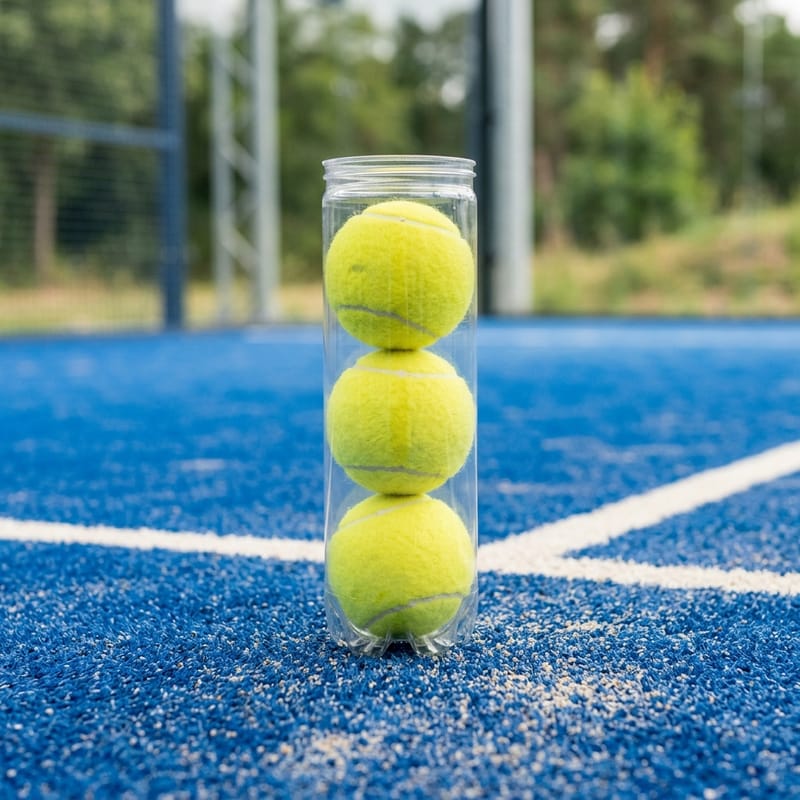
Padel balls look identical to tennis balls on the shelf but behave noticeably differently on court - lower internal pressure, slightly smaller diameter, and a softer rebound profile. The right ball for your game depends on three things: whether you play indoor synthetic or outdoor sand-filled artificial grass, how often you train versus play matches, and whether you can tell the difference between a fresh tube and a 10-hour-old one (most amateurs can't, until they try side by side).
What makes a padel ball different from a tennis ball?
The International Federation of Padel (FIP), the sport's world governing body, specifies that a padel ball must measure 6.35-6.77 cm in diameter and weigh 56-59.4 grams - roughly 0.3 cm smaller and 1-2 g lighter than a regulation tennis ball. More important is the internal pressure: padel balls are pressurised to 4.6-5.2 kg/cm², below tennis spec, which produces a lower rebound off the court (with a softer feel on the racket face).
The practical effect: padel balls sit lower coming off the back glass, demand more wrist work on viboras, and reward racket head speed over pure power. Use a tennis ball on a padel court for an hour and you'll notice the difference - the bounce is too lively, the wall returns sit too high, and the back-court rallies break down quickly.
WPT-spec match balls vs club balls vs trainers
UK retailers stock three meaningful tiers. The differences are in felt density, core construction, and how long the ball keeps its first-tube feel.
WPT-spec match balls are approved for use on the Premier Padel and FIP World Tour circuits. They have premium felt, denser cores, and hold pressure longer than the cheaper tiers. Expect £4-6 per tube of 3 and 6-10 hours of usable play before the bounce flattens noticeably. Examples: Head Pro S, Bullpadel Premium Pro, Wilson Tour, WPT Official.
Club balls sit just below tour spec - same outer dimensions, same surface feel for the first session, but a less dense core that loses pressure faster. Good value for league players who go through balls weekly. Expect £3-4 per tube and 4-6 hours of useful play. Examples: Wilson X3, Babolat Court, Head Padel Pro.
Trainer balls use cheaper felt and unpressurised or low-pressure cores. They feel dead from the first hit and don't develop the lively rebound profile real padel balls have, but they last for 30+ hours. Useful for solo wall practice or coaching kids - not for competitive play. Expect £1-2 per ball, sold individually or in 12-packs.
Five UK ball picks for 2026
| Head Pro S | Bullpadel Premium Pro | WPT Official | Wilson X3 | Babolat Court | |
|---|---|---|---|---|---|
| Tier | WPT-spec match | WPT-spec match | WPT-spec match | Club | Club |
| Approval | Premier Padel tour ball | FIP-approved | World Padel Tour branded | FIP-approved | Not tour-approved |
| Usable hours | 8-10 | 7-9 | 6-9 | 5-7 | 4-6 |
| Surface | Indoor + outdoor | Indoor + outdoor | Indoor + outdoor | All surfaces | Indoor preferred |
| Best for | League matches, tournament play | Players already on Bullpadel gear | Match-spec consistency on a budget | Weekly club sessions, social play | High-frequency practice |
How quickly do padel balls go off?
The honest answer most retailers won't put on the tube: padel balls lose meaningful pressure within 6-10 hours of court time, and the drop-off is not linear. A fresh tube plays at full pressure for the first 2-3 sessions, then degrades steeply through hours 4-8, then flattens into a plateau where the ball is still playable but no longer rebounds off the back glass like it did when new. Beyond ~10 hours, even the premium tour balls feel dead.
This is dramatically faster than tennis balls - which is why every padel club's reception desk has a stack of tubes for sale. Plan for a fresh tube every 1-2 weeks at typical 2-3-session-a-week amateur frequency. If you're playing 4+ sessions a week, you're realistically buying balls every week.
Storage helps. A pressurised storage cylinder (Tuboplus and Press Saver are the two brands UK retailers stock) maintains internal pressure between sessions and adds 1-2 hours of life to a tube. They cost £15-25 and recoup the spend within 2-3 months for regular players.
Indoor vs outdoor: does the surface change which ball to buy?
Slightly. UK courts are split roughly 60/40 indoor (synthetic carpet) to outdoor (sand-filled artificial grass), and the surface affects how quickly the felt wears.
On outdoor sand-filled grass, the felt picks up sand particles that act as fine abrasive. Felt thins faster, the ball gets less responsive off the glass earlier, and tube life drops 20-30% compared to indoor. Head Pro S and Bullpadel Premium Pro hold up best - both use denser felt construction that resists pilling.
On indoor synthetic carpet, balls last longer (the surface is smoother and less abrasive) but pick up dust that subtly affects bounce. Wipe balls with a slightly damp cloth between sessions to extend usable life.
For mixed-surface league players who play both indoor and outdoor venues, a WPT-spec ball is the safest pick - the premium felt copes with the abrasive outdoor surface without sacrificing indoor feel.
Where to buy padel balls in the UK
Padel-Point UK, All Things Tennis, and Express Padel carry the full WPT-spec range with UK warehousing. Decathlon stocks Babolat Court and entry-tier balls at the best per-tube price for high-volume buyers. Amazon UK is the easiest fallback for one-off tube purchases but typically prices 10-15% above the specialist retailers - check before buying.
Bulk pricing meaningfully reduces per-tube cost for league players: most retailers price tubes individually at £4-6 but drop to £3-4 per tube at 12-tube boxes. Worth coordinating with your club's regular doubles partners to share a box.
Frequently asked questions
Can you use tennis balls for padel?
Are WPT-spec balls worth the extra cost?
How long do padel balls last unopened?
Do padel balls work for tennis?
Are unbranded supermarket padel balls okay?
Best Padel Rackets UK 2026
Best Padel Shoes UK 2026
Padel for Beginners UK 2026