Padel Court Types: Panoramic vs Corner vs Multisport
Padel court types explained: panoramic, standard corner, and multisport courts - how each one plays, what to look for, and which suits your game best.
Every padel court is the same size - 20 metres by 10 for doubles - but they are not all built the same way, and the differences change how the ball comes off the walls and how the game feels. Knowing the types helps you pick a venue, read a booking listing, and understand why a shot that died at one club rebounds beautifully at another.
The walls are the whole point of padel - the ball stays in play off the glass and mesh, which is what separates it from tennis. So the construction of those walls, and whether they are glass or mesh at any given point, matters more than in any other racket sport. This guide breaks down the three court types you will actually encounter in the UK, how each plays, and which to seek out.
What are the main types of padel court?
Padel courts are classified mainly by how their walls are built and what the surface is used for. The three you will meet in practice are the standard corner court, the panoramic court, and the multisport or convertible court. All three share the same playing dimensions and the same rules; the differences are in build quality, wall material, and how cleanly the ball rebounds.
There is also a separate split by size - a doubles court is 20m by 10m, while a singles court is the same length but only 6m wide. Most UK clubs run doubles courts because padel is overwhelmingly a four-player game. Within the doubles format, the corner-versus-panoramic distinction is the one that affects your experience most.
What is a standard (corner) padel court?
The standard court - often called a corner court (a build where metal support posts sit at the corners of the playing area, between the glass and the side mesh) - is the most common design and the one used for most competition. The back walls are toughened glass, usually three metres of glass with a metre of metal mesh above, and the long sides are mesh with a glass section near the back corners.
The defining feature is the metal post at each corner of the play area where the glass meets the mesh. The ball behaves differently off glass than off mesh: glass gives a true, predictable bounce, while mesh kills pace and can send the ball off at an awkward angle. On a corner court you learn to read both, and the corner posts themselves occasionally produce an unpredictable ricochet. This is the everyday court most UK players learn on, and it is perfectly good - the quirks are part of the game's character. To learn how to use the walls tactically, see our guide to court positioning fundamentals.
What is a panoramic padel court?
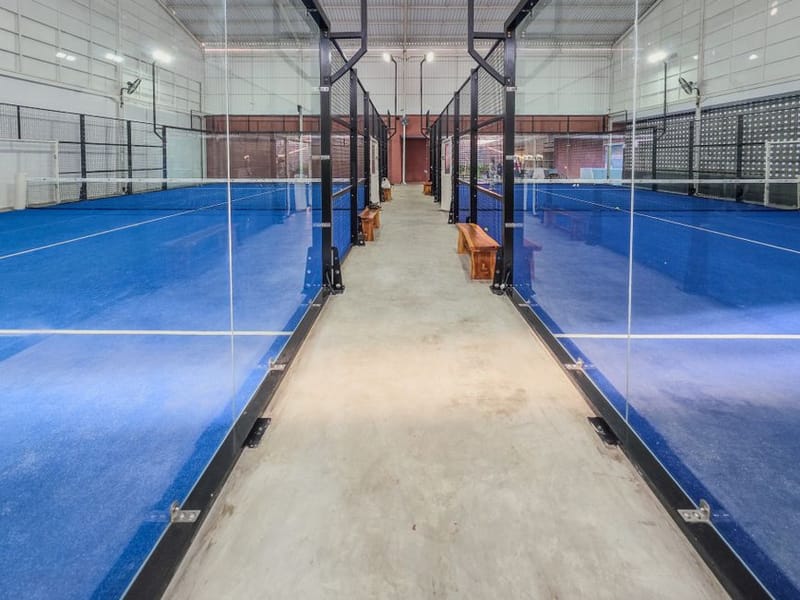
A panoramic court (a structural-glass build with no metal posts interrupting the playing-area corners) replaces the corner posts with thick, self-supporting glass, giving an uninterrupted glass surface around the back and into the corners. The result is a cleaner, more predictable rebound everywhere on the court, and a noticeably more open, premium feel.
Two things make panoramic courts desirable. First, the ball comes off the corners truly, with no post to deflect it, so wall play is more rewarding and consistent. Second, spectators get an unobstructed view through the glass, which is why almost every televised professional match is played on a panoramic court. The trade-off is cost: structural glass is more expensive to build and install, so panoramic courts command higher booking fees and are more common at newer, premium venues. If you are choosing where to improve your wall game, a panoramic court is the better teacher.
What is a multisport or convertible court?
A multisport court is a shared-use facility where padel lines sit alongside markings for other sports, or where a tennis court or sports hall has been adapted for padel. These are common at leisure centres and schools adding padel without dedicating a permanent court to it.
The compromise is in the detail. Multisport setups often use more mesh and less glass, may have non-standard wall heights, and sometimes sit on surfaces not optimised for padel's sand-filled artificial turf. The ball can play slower or less predictably, and extra line markings can be visually distracting. For a casual hit or a first try, a multisport court is completely fine and keeps padel accessible. For serious practice or matches where wall play matters, a dedicated corner or panoramic court is worth seeking out.
Does court type change how the ball plays?
Yes, more than most beginners expect. Glass returns the ball with pace and a true angle, so a shot into the back glass comes back playable and you can set up a counter. Mesh absorbs pace and deadens the bounce, so balls into the side fencing sit up shorter and lower. The more glass a court has, the more the ball stays lively off the walls - which rewards patient, wall-based rallies.
This is why players who learn on a heavily meshed multisport court sometimes struggle when they move to a glass-rich panoramic one: the ball is suddenly faster off the back, and they are late on the rebound. Spending time on different court types makes you a more adaptable player, and it is one reason wall practice transfers so well between venues. Our guide to solo drills covers wall work you can do on any court type.
Indoor vs outdoor: does it matter?
Court type and indoor-versus-outdoor are separate questions, and both affect play. Indoor courts remove wind and rain, give consistent lighting, and protect the surface, so the bounce stays uniform year-round - a real advantage in the UK climate. Outdoor courts are cheaper to book and pleasant in good weather, but wind moves the ball and a damp surface slows it and reduces grip.
You will find corner, panoramic, and multisport builds both indoors and out. If consistency matters to you - for lessons, league matches, or simply reliable winter play - an indoor panoramic or corner court is the gold standard. For a relaxed summer game, an outdoor court is part of the appeal. Browse what is near you in our where to play padel in the UK guide.
Which court type should you look for?
Match the court to your goal. If you are improving your wall game or playing competitively, book a panoramic court when you can - the clean glass rebound is the best teacher and the closest thing to tournament conditions. For everyday play, a standard corner court is the reliable default and what most leagues use, so you should be comfortable on one regardless. A multisport court is fine for a casual session, a first taste of padel, or when it is the only option nearby.
In practice, availability and price decide more than preference: panoramic courts cost more and book up faster. The most useful habit is to play across all three types so your game does not depend on one particular wall behaviour. If you are weighing up building or running courts rather than just playing on them, our padel court cost guide covers how build type drives the budget.
Frequently asked questions
What is the difference between a panoramic and a standard padel court?
Are all padel courts the same size?
Is a multisport court bad for padel?
Which court type is used in professional padel?

Where to Play Padel in the UK
Padel Court Positioning Fundamentals

Padel Solo Drills