The Out-of-Court Ball in Padel: Playing Through the Door
The out-of-court ball in padel explained: when you can chase a ball through the door and play it back, the rules, which courts allow it, and how to do it.
Few things in padel look as dramatic as a player sprinting out through the side door, catching a ball mid-flight outside the court, and curling it back in for a winner. It's a legal, point-winning shot - but only under specific conditions. Here's exactly when the out-of-court ball is on, the rules that govern it, and how to pull it off.
What is the out-of-court ball in padel?
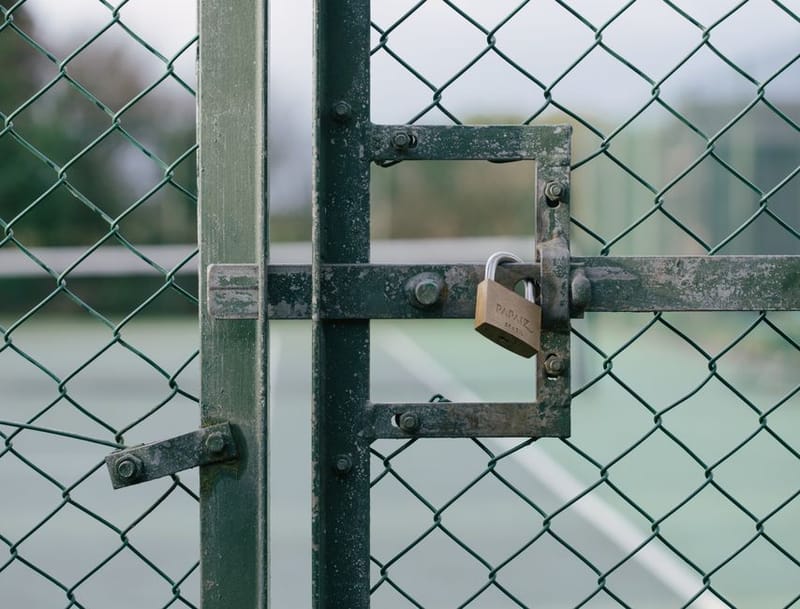
Padel courts are enclosed, but many have open access points - doors or gaps in the side fencing (often called playing through the puerta, Spanish for door). When a hard, low ball bounces in your court and then flies out through one of those gaps or over the fence, the point isn't necessarily over. You're allowed to run out of the court, play the ball from outside, and send it back in - and if it lands in the opponents' court, you win the point. It is the shot that lets padel rallies continue beyond the court walls, and it's a real crowd-pleaser.
When is it legal to play the ball outside the court?
The rules are precise, and one condition matters above all:
- The ball must have bounced inside your court first. This is the deal-breaker. If the ball leaves the court without bouncing on your floor - flying straight out over the wall or fence - it is simply out, and you've lost the point. It only becomes playable once it has bounced in.
- You must return it over the net and into the opponents' court. Playing it back from outside still has to clear the net and land in, just like any shot.
- The normal one-bounce rule applies. You can only let it bounce once (outside the court) before you hit it - you cannot let it bounce twice.
Get those right and the point continues. It's the bounce-inside-first rule that catches people out - chasing a ball that never bounced is wasted effort.
Which courts allow out-of-court play?
Not every court is set up for it. Out-of-court play needs access points (doors) in the side fencing and enough safe run-off space around the court. Under the International Padel Federation's rules, the safety corridor around the court was increased for 2026 to a minimum of 3 metres (4 metres recommended), with each side of the court required to have two access points. Older or tightly-packed club courts with little surrounding space, walls instead of open gaps, or no run-off, effectively don't allow it - there's nowhere safe to chase the ball. So whether the shot is even possible depends on the venue. For the full court spec, see our padel court dimensions guide.
How do you play the out-of-court ball?
It's about anticipation and speed more than technique:
- Read it early. The moment a hard, low ball bounces and kicks toward the door, commit - you have a split second to decide.
- Sprint to the door, not the ball. Head for the access gap and get outside; chasing the ball directly into the fence wastes time.
- Get your racket on it cleanly and aim for the open court - a flat, controlled return is far more reliable than trying to do too much.
- Recover fast. You're now well outside the court and badly out of position, so even a successful return means scrambling back. Many players hit a great out-of-court shot and then lose the next ball.
It's an advanced, situational shot - master your side-wall play and court positioning first; the out-of-court ball is the icing, not the cake.
How do you defend against it?
If you've hit a shot hard enough to send your opponent out the door, you're in a strong position - but don't relax. The returner is outside the court and scrambling, so the smart play is to be ready at the net for a weak, floated reply and put it away into the open space they've vacated. The biggest mistake is ball-watching the spectacular get instead of preparing your next shot. Stay on your toes and the point is usually yours.
Frequently asked questions
Can you play the ball outside the court in padel?
Does the ball have to bounce before you can play it outside the court?
Why can't I play out of the court at my club?
Is the out-of-court shot worth attempting?
What is 'playing through the door' in padel?

Padel Rules: The Complete Guide

Padel Side Wall Play
Padel Court Positioning Fundamentals