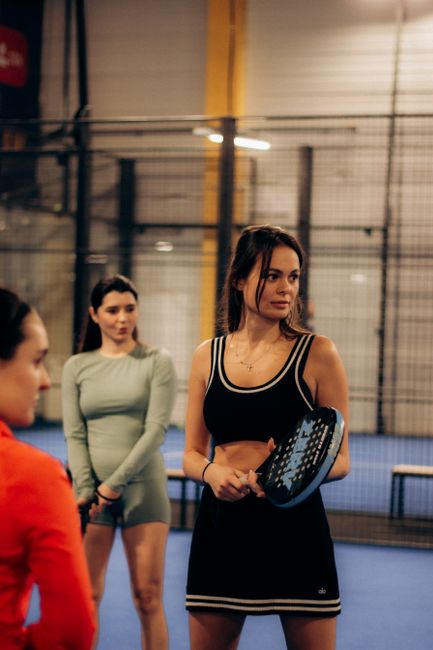
Padel vs Paddle Tennis (2026): The Honest Difference
Padel and paddle tennis are different sports - Spanish-origin glass-walled doubles vs American small-court singles. The honest difference explained.
UK Google searches for 'paddle tennis' have grown rapidly since 2022, but the sport people are usually looking for is padel - a different sport. This is the most common UK racquet-sport confusion. This explainer covers the actual differences and why the linguistic mix-up matters when you're booking a court or buying equipment.
What's the short version - padel vs paddle tennis?
| Padel | Paddle Tennis | |
|---|---|---|
| Origin | Mexico/Spain, 1969 (Enrique Corcuera, Acapulco) | USA, 1898 (Frank Peer Beal, New York) |
| Court | 10m × 20m enclosed | 15.2m × 6.1m (50' × 20') open |
| Walls | Glass (back + part of side) - the ball plays off them | None |
| Net height | 0.88 m at centre | 0.79 m at centre |
| Format | Doubles only (competitive); singles court exists but is rare | Singles or doubles |
| Racquet | Solid paddle, perforated carbon/fibreglass face, ~365-375g | Solid paddle, perforated face, smaller and lighter than padel (~280g) |
| Ball | Lower-pressure tennis ball (6.35-6.77cm, ~5.8 kg/cm² pressure) | Tennis ball with depressurised pressure ("pop" ball, lower bounce) |
| UK status | Fastest-growing racquet sport in UK 2022-2026; ~400+ venues | Effectively absent - almost no UK venues |
| Pro tour | Premier Padel, FIP World Tour | American Paddle Association (regional US play only) |
Why the name confusion?
Two reasons.
Translation. The Spanish word for padel is 'pádel' (with the accent), pronounced more like 'pah-dell'. English speakers naturally write that as 'paddle' because the racquet looks like a paddle and the spelling maps. So when padel arrived in the UK, the casual translation became 'paddle tennis' - but that's the name of a different American sport. Editorial outlets gradually settled on the Spanish-origin 'padel' (no accent in English) to avoid the collision, but the original confusion stuck in casual search behaviour.
Surface similarity. Both sports use solid paddles (not strung racquets), both play on smaller-than-tennis courts, and both feel like tennis variants. To a viewer who doesn't know the technical rules, they look like the same sport. The differences only become obvious once you've played both - which most people haven't, because paddle tennis is genuinely niche outside the US.
Why padel grew (and paddle tennis didn't) in the UK
Padel's UK explosion (2022 onwards) comes from a specific structural advantage: the enclosed court with glass walls makes rallies longer and more entertaining at the amateur level than tennis or paddle tennis. A tennis rally between two club-level amateurs often ends in 2-3 shots (serve, return, error); a padel rally at the same level commonly runs 8-15 shots because the walls keep the ball in play.
Long rallies = more fun for casual social play = wider adoption. Combined with the doubles-only format (which lowers individual skill requirements and makes the sport accessible to mixed-ability groups), padel has the right shape for the UK club-and-leisure market.
Paddle tennis's open-court singles format doesn't have any of those structural advantages. It's a perfectly fine sport - but without the wall game and the doubles-by-default format, it's effectively a tennis variant rather than a distinct experience. UK clubs that considered both ultimately chose padel.
If you're searching 'paddle tennis UK' - what you probably want
If you want to play casual racquet sport on a smaller court → padel. The UK has 400+ padel venues as of 2026; paddle tennis effectively has none. See our UK courts directory.
If you want to buy a 'paddle tennis racquet' → you almost certainly want a padel racquet. The shape and weight are different. See our 2026 racket rankings for the right starter buy.
If you're watching pro 'paddle tennis' on YouTube → that's almost certainly Premier Padel or FIP World Tour padel. The American paddle tennis pro circuit is small and rarely streamed internationally.
If you genuinely want American paddle tennis → the American Paddle Association is the governing body; play is concentrated in California and Florida. UK venues with paddle tennis courts are rare-to-nonexistent.
What about platform tennis and pickleball?
Two more racquet sports that get caught up in the confusion.
Platform tennis (sometimes called 'paddle' in the US northeast) is yet another distinct sport - outdoor, on a heated raised platform, with a fenced cage instead of walls, played in cold weather. Niche even in the US; effectively absent in the UK.
Pickleball is the other small-court paddle-and-perforated-ball sport that's growing fast. Pickleball is different again: smaller plastic ball with low bounce, no glass walls, smaller court (13.4 × 6.10m, similar to badminton). See our padel vs pickleball comparison for the deeper comparison - and our pickleball-side companion piece for the converse framing.
Frequently asked questions
Is padel the same as paddle tennis?
Why do UK people search for 'paddle tennis' when they mean padel?
Can I play paddle tennis at UK padel venues?
Which is harder to learn?
Should I buy a padel racquet or a paddle tennis racquet?
Padel vs Pickleball UK
Padel vs Tennis
Where to Play Padel in the UK