Common Padel Beginner Mistakes (and Fixes) 2026
The most common padel beginner mistakes and how to fix them: hitting too hard, not using the walls, poor positioning and rushing the net.
Padel is famously easy to start and surprisingly hard to play well, and most beginners hold themselves back with the same handful of habits carried over from tennis or simple inexperience. The good news is that they are easy to fix once you know them. Here are the mistakes that cost new players the most, and how to put each one right.
Why do beginners hit the ball too hard?
The number one mistake is trying to smash everything. In padel (an enclosed-court racket sport), power without control just hands the point to your opponents, because a hard, loose shot sits up off the back wall for an easy reply. Beginners coming from tennis especially over-hit. The fix is to take pace off, aim for placement, and treat control as the priority. A soft, well-placed ball to your opponents' feet wins far more padel points than a wild winner. Build the habit with our beginner's guide.
Why should you use the walls?
The second big mistake is panicking when the ball goes past you and treating it as lost, instead of letting it rebound off the back glass and playing it on the way back. The walls are what make padel padel, and refusing to use them gives away half the court. New players should learn early to turn side-on, give the ball room, and take it after the rebound, as covered in our back-glass guide. It feels unnatural at first but quickly becomes the most reliable shot in your game.
Where do beginners stand wrong?
Poor positioning is the third mistake. Beginners often stand too far forward in no-man's land, get stuck mid-court, or fail to move with their partner as a unit. The pair should move together, both up at the net or both back, never split front-and-back, and should leave room behind them to use the back wall. Standing too close to the glass is another common error, jamming your own swing. Our positioning guide covers where to stand and when to move.
Why is rushing the net a mistake?
Winning the net is the goal, but rushing forward off a poor shot is the fourth common error. If you charge the net behind a weak, high ball, you get passed or lobbed easily. The right way to take the net is behind a controlled, low shot such as a chiquita or a deep return that forces a weak reply, then advancing as a pair. Patience here, waiting for the right ball to move up behind, separates players who hold the net from those who keep getting pushed back.
What other mistakes hold beginners back?
A few smaller habits add up. Gripping the racket too tightly kills feel and tires the arm; hold it relaxed. Ignoring the serve and return as a controlled, tactical exchange, rather than a chance to attack, costs early points. Skipping the split step leaves you flat-footed and slow. And buying a stiff, advanced racket too early makes everything harder; a forgiving frame suits a beginner far better, as our beginner racket guide explains. Fix the big four first, then tidy up these.
How do you improve fastest as a beginner?
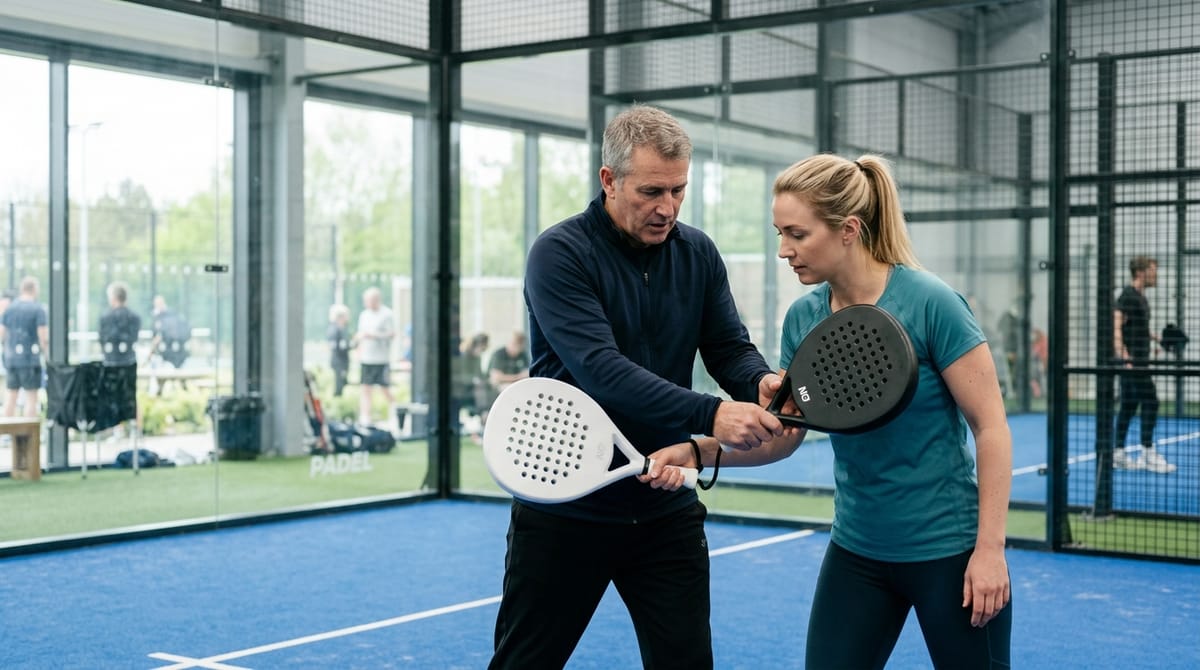
Focus on one habit at a time rather than everything at once. Spend a session only taking pace off and placing the ball, then a session only using the back wall, then one only on positioning with your partner. A few lessons with a coach short-cut months of trial and error, because most of these mistakes are invisible to the player making them. Above all, embrace that padel is a thinking, patient game; the quickest improvement comes from playing percentages and winning the net, not from hitting harder.
Frequently asked questions
What is the most common mistake in padel?
Should beginners use the walls in padel?
When should a beginner move to the net?
What racket should a beginner avoid?

Padel for Beginners UK 2026

How to Play Off the Back Glass in Padel