Teardrop Head Shape Padel Rackets: The All-Rounder's Guide
Teardrop padel rackets balance power and control in one frame. What the shape does, who it suits, how to choose one, and our standout UK teardrop picks.
Head shape is the first thing that decides how a padel racket plays, and teardrop is the shape that refuses to pick a side. By sitting the sweet spot mid-face - higher than a round frame, lower than a diamond - a teardrop gives you meaningful power on the smash without shrinking the hitting area to expert-only proportions. If your game has outgrown a beginner round racket but a full power frame still punishes your mishits, teardrop is the natural next step.
What is a teardrop head shape padel racket?
Padel rackets come in three head shapes: round, teardrop and diamond. The shape controls where the sweet spot sits and how the frame's weight is distributed. On a teardrop the widest part of the head sits just above the middle of the face, so the sweet spot lands mid-face with a medium balance - the geometric compromise between a round frame's low, centred mass and a diamond's tip-heavy load.
That middle position is what makes the shape so adaptable. There is enough mass above your hand to add real pace to overheads and volleys, but the sweet spot stays large and close enough to the centre that off-centre hits are still workable. Manufacturers often blur the edges of the category - you will see "hybrid" frames that sit between round and teardrop, and aggressive teardrops that edge towards diamond - but the mid-face sweet spot is the defining trait.
Who should use a teardrop padel racket?
Improving intermediates
You rally consistently and want to start finishing points with pace, without giving up the forgiveness that got you here.
All-court players
If you defend, counter and attack in equal measure, the balanced sweet spot rewards every part of that game rather than one extreme.
Players moving up from a round frame
Teardrop is the standard second racket: familiar enough to keep your control game, powerful enough to grow into.
Anyone who wants one racket for everything
Club players who play socially and competitively in the same week get the fewest compromises from a teardrop.
The trade-off is that a teardrop is not the best at either extreme. A pure control player will find a round frame more forgiving on defence, and a technically clean attacker will get more free power from a diamond. Teardrop is for the large majority of players in between - which is exactly why it is often called the safest choice in padel.
Teardrop vs round vs diamond: how do the shapes differ?
The three shapes sit on a spectrum from control to power. Round is the control end, diamond is the power end, and teardrop holds the middle ground. Our full diamond vs round vs teardrop comparison goes deeper, and the round head shape guide covers the control end in detail. Here is the short version.
Head shape at a glance
- Round
- Sweet spot low/centred - most control, largest sweet spot, most forgiving, least power. Best for beginners and control players.
- Teardrop
- Sweet spot mid-face - balanced power and control, most versatile. Best for improving intermediates who want a bit of everything.
- Diamond
- Sweet spot high near the tip - most power, smallest sweet spot, least forgiving. Best for advanced, aggressive players with clean technique.
What are the pros and cons of a teardrop racket?
What we liked
- The most versatile shape - competent in attack and defence alike
- Meaningful smash power without a diamond's unforgiving sweet spot
- Large enough hitting area for intermediates to swing with confidence
- The natural upgrade path from a beginner round frame
- Huge model choice - most brands make their core range in teardrop or hybrid shapes
Watch out for
- Less forgiving than a round frame on mistimed defensive shots
- Less free power at the top end than a true diamond
- Medium-high balance versions can work the arm harder than a round racket
- The "hybrid" label is used loosely - specs matter more than the marketing name
How does a teardrop racket change the way you play?
Moving to a teardrop changes the attacking half of your game most. Overheads that used to be a reset become a weapon: the extra mass above your hand adds pace to the smash and the bandeja without you swinging harder. Volleys carry more authority too, so you can finish net exchanges a shot or two earlier than a round frame allows.
On defence the shape asks slightly more of you. The sweet spot is still generous, but it sits higher, so scrambling digs off the back glass reward a prepared, early racket face more than a round frame would. Most improving players adjust within a few sessions, and the payoff is a game with no obvious hole: you no longer have to manufacture power on the finish or baby the ball on defence. That balance is why so many club players settle on a teardrop and stay there for years.
How do you choose a good teardrop padel racket?
Once you have settled on a teardrop shape, four things separate a good one from a frustrating one:
- Weight. Aim for roughly 355-375g. Lighter teardrops stay manoeuvrable and arm-friendly; heavier ones add smash power but tire you late in a match.
- Balance. This is where teardrops vary most. A medium balance keeps the all-round character; a higher balance turns the racket into a near-diamond. Check the number on the spec sheet, not just the silhouette.
- Core. A softer EVA core adds comfort and control; a harder core sharpens power at the cost of forgiveness. Our guide to padel racket cores covers the differences in detail.
- Face material. Fibreglass faces are softer and more forgiving; full carbon is stiffer and more responsive. A carbon face over a soft core is a popular teardrop recipe - see carbon vs fibreglass for the trade-offs.
If you are weighing shape, weight and balance together for the first time, our how to choose a padel racket guide walks through the full decision, and the best intermediate padel rackets roundup shows where teardrops dominate.
What is our standout teardrop padel racket in the UK?
The balanced middle of the market is crowded, but the Bullpadel Vertex 05 is the clearest expression of it in our current lineup. Bullpadel positions it as a hybrid between round and teardrop, which in practice means exactly what teardrop buyers are shopping for: real pace on the overhead with a hitting area that forgives an imperfect strike. We compare it directly against two popular alternatives in Vertex 05 vs Hack 04 and Technical Viper vs Vertex 05.
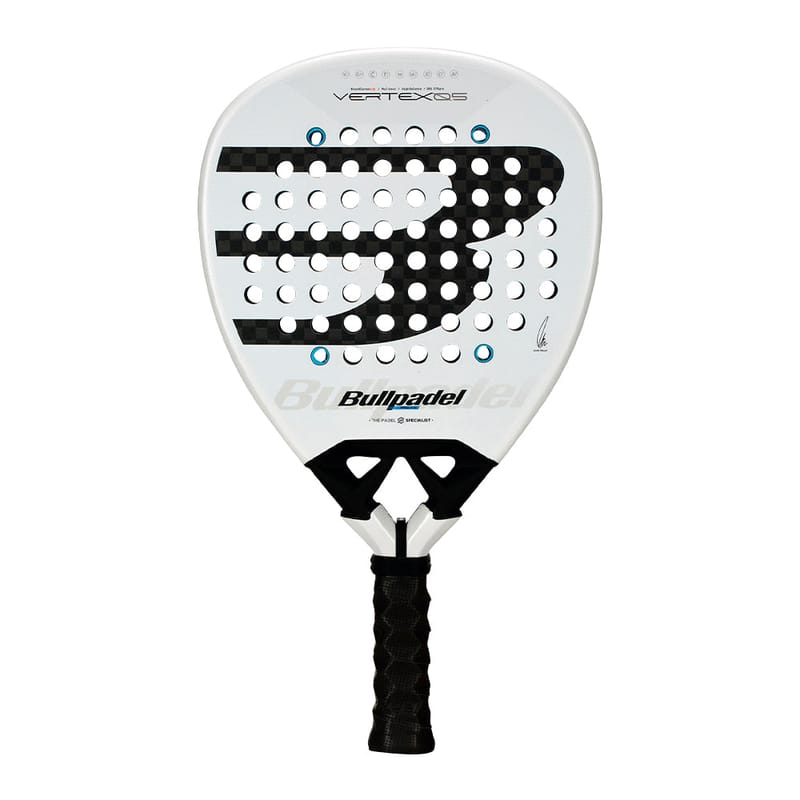
Bullpadel Vertex 05 2026
Bullpadel Vertex 05 2026: Tello's hybrid-shape signature. Medium balance, 12K carbon, MultiEVA core. Control with finishing power for advanced play.
Check priceTwo other teardrops from our reviews are worth a look depending on your budget and priorities. The Varlion Maxima Cube Elbowcare W pairs the teardrop shape with Varlion's arm-protecting construction, a strong choice if elbow comfort is a deciding factor. At the premium end, the Cork Padel Extreme Black II is a high-end teardrop-hybrid for players who want tour-level materials in a balanced frame.
Do professional players use teardrop rackets?
Yes - teardrop and hybrid shapes are well represented on the professional tours, particularly among players known for all-court versatility rather than pure aggression. Out-and-out attackers still tend to favour diamond frames for maximum finishing power, but the balanced middle of the spectrum is far from an amateur-only zone.
For club players the takeaway is encouraging: choosing a teardrop is not a compromise you will grow out of. Because the shape scales with technique - better timing unlocks more of its power - a good teardrop can carry a player from low intermediate to advanced without ever feeling like the limiting factor.
Frequently asked questions
Is a teardrop padel racket good for beginners?
Is a teardrop or diamond racket better for power?
What is the difference between a teardrop and a hybrid padel racket?
What weight should a teardrop padel racket be?
Are teardrop rackets good for intermediate players?
Sources
Diamond vs Round vs Teardrop Padel Rackets